About
BLOG

Interested in a little light reading?

Our blog is continually updated with helpful educational information, advises, research and insights—all in the name of helping you level-up your color and appearance needs. Grab a drink and enjoy our stories!

Explore Our Stories
10-03-05-07-msez-cmr-3105-msez-screen-capture-of-various-beta-display-options.jpg

"What is a Y Brightness? Beta Reflectance Factor? Reflection Coefficient?"

Read More

Explore Our Products

VIEW MORE

10-03-05-07-msez-cmr-3105-msez-screen-capture-of-various-beta-display-options.jpg

"What is a Y Brightness? Beta Reflectance Factor? Reflection Coefficient?"

Read More
10-03-05-07-msez-cmr-3105-msez-screen-capture-of-various-beta-display-options.jpg

"What is a Y Brightness? Beta Reflectance Factor? Reflection Coefficient?"

Read More
10-03-05-07-msez-cmr-3105-msez-screen-capture-of-various-beta-display-options.jpg

"What is a Y Brightness? Beta Reflectance Factor? Reflection Coefficient?"

Read More
10-03-05-07-msez-cmr-3105-msez-screen-capture-of-various-beta-display-options.jpg

"What is a Y Brightness? Beta Reflectance Factor? Reflection Coefficient?"

Read More
10-03-05-07-msez-cmr-3105-msez-screen-capture-of-various-beta-display-options.jpg

"What is a Y Brightness? Beta Reflectance Factor? Reflection Coefficient?"

Read More

What is a Y Brightness? Beta Reflectance Factor? Reflection Coefficient?

Posted on Dec 19, 2025 by HunterLab

FAQ: What is a Y Brightness/Luminance?

FAQ: What is a Beta (ß) Reflectance or Luminance Factor for Brightness?

FAQ: What is a Reflection Coefficient (0-1)?

ASTM E284 Standard Terminology of Appearance defines reflectance factor as:

Reflectance Factor, n – ratio of the flux reflected from the specimen relative to the flux reflected from the perfect reflecting diffuser under the same geometric and spectral conditions of measurement.

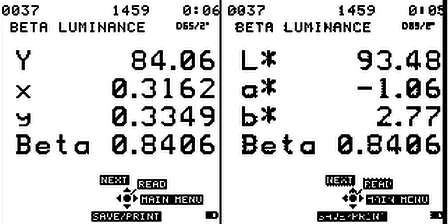
The most common metric used to measure the brightness of materials is CIE Y Brightness or Luminance. The CIE Y metric is scaled between 0 (representing a Perfect Black of 0% reflectance across the visible spectrum) and 100 (representing a Perfect White of 100% reflectance across the visible spectrum).

The “ß (beta) reflectance or luminance factor” is the same as Y Brightness or Luminance, expressed as a ratio relative to base 1 instead of 100.

Another metric called “Reflection Coefficient, Visible (0-1)” is the same as ß (beta) reflectance factor: scaling the reflectance of the material between 0 for a perfect black and 1 for a perfect white.

In all cases the illuminant/observer combination used for calculation has been C/2° historically, but measurements of typical white or neutral materials, made under D65/10° will be very close.

Here is a table comparing Y Brightness/Beta reflectance and Reflection coefficient for typical white colors.

Posted in Building Products

What is a Y Brightness? Beta Reflectance Factor? Reflection Coefficient?

Posted on Nov 29, 2023 by HunterLab

FAQ: What is a Y Brightness/Luminance?

FAQ: What is a Beta (ß) Reflectance or Luminance Factor for Brightness?

FAQ: What is a Reflection Coefficient (0-1)?

ASTM E284 Standard Terminology of Appearance defines reflectance factor as:

Reflectance Factor, n – ratio of the flux reflected from the specimen relative to the flux reflected from the perfect reflecting diffuser under the same geometric and spectral conditions of measurement.

The most common metric used to measure the brightness of materials is CIE Y Brightness or Luminance. The CIE Y metric is scaled between 0 (representing a Perfect Black of 0% reflectance across the visible spectrum) and 100 (representing a Perfect White of 100% reflectance across the visible spectrum).

The “ß (beta) reflectance or luminance factor” is the same as Y Brightness or Luminance, expressed as a ratio relative to base 1 instead of 100.

Another metric called “Reflection Coefficient, Visible (0-1)” is the same as ß (beta) reflectance factor: scaling the reflectance of the material between 0 for a perfect black and 1 for a perfect white.

In all cases the illuminant/observer combination used for calculation has been C/2° historically, but measurements of typical white or neutral materials, made under D65/10° will be very close.

Here is a table comparing Y Brightness/Beta reflectance and Reflection coefficient for typical white colors.

Posted in Building Products

What is a Y Brightness? Beta Reflectance Factor? Reflection Coefficient?

Posted on Nov 29, 2023 by HunterLab

よくある質問Y輝度/輝度とは何ですか?

よくある質問輝度に対するベータ(ß)反射率または輝度係数とは何ですか?

よくある質問反射係数(0~1)とは何ですか?

ASTM E284 Standard Terminology of Appearanceでは、反射率を次のように定義している:

反射率, n - 同じ幾何学的・分光学的測定条件下で、完全反射拡散板から反射される光束に対する、試料から反射される光束の比率。

材料の明るさを測定するために使用される最も一般的な指標は、CIE Y輝度または輝度です。CIE Y指標は、0(可視スペクトル全体の反射率が0%の完全な黒)から100(可視スペクトル全体の反射率が100%の完全な白)の間でスケーリングされます。

ß (β)反射率または輝度係数」は、Y輝度または輝度と同じで、100の代わりに基準1に対する比率で表されます。

反射係数、可視(0-1)」と呼ばれるもう1つの指標は、ß(ベータ)反射率と同じです。

すべての場合において、計算に使用された照度と観察者の組み合わせは、歴史的にC/2°であったが、D65/10°の下で行われた典型的な白色または中性の材料の測定は、非常に近いものとなる。

代表的な白色について、Y輝度/ベータ反射率と反射率を比較した表です。

Posted in Building Products

What is a Y Brightness? Beta Reflectance Factor? Reflection Coefficient?

Posted on Nov 29, 2023 by HunterLab

FAQ: Was ist eine Y-Helligkeit/Leuchtdichte?

FAQ: Was ist ein Beta (ß) Reflexions- oder Leuchtdichtefaktor für Helligkeit?

FAQ: Was ist ein Reflexionskoeffizient (0-1)?

ASTM E284 Standard Terminology of Appearance definiert den Reflexionsfaktor als:

Reflexionsfaktor, n - Verhältnis des von der Probe reflektierten Lichtstroms zu dem von einem perfekt reflektierenden Diffusor reflektierten Lichtstrom unter denselben geometrischen und spektralen Messbedingungen.

Die gebräuchlichste Metrik zur Messung der Helligkeit von Materialien ist die CIE Y-Helligkeit oder Leuchtdichte. Die CIE Y-Metrik wird zwischen 0 (für ein perfektes Schwarz mit 0 % Reflexionsgrad im sichtbaren Spektrum) und 100 (für ein perfektes Weiß mit 100 % Reflexionsgrad im sichtbaren Spektrum) skaliert.

Der "ß (Beta)-Reflexions- oder Leuchtdichtefaktor" ist dasselbe wie die Y-Helligkeit oder Leuchtdichte, ausgedrückt als Verhältnis zur Basis 1 statt 100.

Eine andere Metrik mit der Bezeichnung "Reflexionskoeffizient, sichtbar (0-1)" ist dasselbe wie der ß (Beta)-Reflexionsfaktor: Sie skaliert den Reflexionsgrad des Materials zwischen 0 für ein perfektes Schwarz und 1 für ein perfektes Weiß.

In allen Fällen war die für die Berechnung verwendete Kombination aus Beleuchtungsstärke und Beobachter in der Vergangenheit C/2°, aber Messungen typischer weißer oder neutraler Materialien, die unter D65/10° durchgeführt wurden, kommen dem sehr nahe.

In der folgenden Tabelle werden Y-Helligkeit/Beta-Reflexionsgrad und Reflexionskoeffizient für typische weiße Farben verglichen.

Posted in Building Products

What is a Y Brightness? Beta Reflectance Factor? Reflection Coefficient?

Posted on Nov 29, 2023 by HunterLab

FAQ: What is a Y Brightness/Luminance?

FAQ: What is a Beta (ß) Reflectance or Luminance Factor for Brightness?

FAQ: What is a Reflection Coefficient (0-1)?

ASTM E284 Standard Terminology of Appearance defines reflectance factor as:

Reflectance Factor, n – ratio of the flux reflected from the specimen relative to the flux reflected from the perfect reflecting diffuser under the same geometric and spectral conditions of measurement.

The most common metric used to measure the brightness of materials is CIE Y Brightness or Luminance. The CIE Y metric is scaled between 0 (representing a Perfect Black of 0% reflectance across the visible spectrum) and 100 (representing a Perfect White of 100% reflectance across the visible spectrum).

The “ß (beta) reflectance or luminance factor” is the same as Y Brightness or Luminance, expressed as a ratio relative to base 1 instead of 100.

Another metric called “Reflection Coefficient, Visible (0-1)” is the same as ß (beta) reflectance factor: scaling the reflectance of the material between 0 for a perfect black and 1 for a perfect white.

In all cases the illuminant/observer combination used for calculation has been C/2° historically, but measurements of typical white or neutral materials, made under D65/10° will be very close.

Here is a table comparing Y Brightness/Beta reflectance and Reflection coefficient for typical white colors.

Posted in Building Products

What is a Y Brightness? Beta Reflectance Factor? Reflection Coefficient?

Posted on Nov 29, 2023 by HunterLab

PREGUNTAS FRECUENTES: ¿Qué es un brillo/luminancia Y?

PREGUNTAS FRECUENTES: ¿Qué es un factor beta (ß) de reflectancia o luminancia para la luminosidad?

PREGUNTAS FRECUENTES: ¿Qué es un coeficiente de reflexión (0-1)?

ASTM E284 Standard Terminology of Appearance define el factor de reflectancia como:

Factor de reflectancia, n - relación entre el flujo reflejado por la muestra y el flujo reflejado por el difusor reflectante perfecto en las mismas condiciones geométricas y espectrales de medición.

La métrica más utilizada para medir el brillo de los materiales es el brillo CIE Y o luminancia. La métrica CIE Y se escala entre 0 (que representa un Negro Perfecto de 0% de reflectancia en todo el espectro visible) y 100 (que representa un Blanco Perfecto de 100% de reflectancia en todo el espectro visible).

El "ß (beta) factor de reflectancia o luminancia" es el mismo que el Brillo o Luminancia Y, expresado como un cociente relativo a la base 1 en lugar de 100.

Otra métrica llamada "Coeficiente de Reflexión, Visible (0-1)" es lo mismo que el factor de reflectancia ß (beta): escalar la reflectancia del material entre 0 para un negro perfecto y 1 para un blanco perfecto.

En todos los casos, la combinación iluminante/observador utilizada para el cálculo ha sido históricamente C/2°, pero las mediciones de materiales blancos o neutros típicos, realizadas bajo D65/10° serán muy próximas.

He aquí una tabla comparativa entre el brillo Y/reflexión beta y el coeficiente de reflexión de los colores blancos típicos.

Posted in Building Products
Prev
1
Next

Most Related Posts

  • What is a Y Brightness? Beta Reflectance Factor? Reflection Coefficient?
  • What is a Y Brightness? Beta Reflectance Factor? Reflection Coefficient?
  • What is a Y Brightness? Beta Reflectance Factor? Reflection Coefficient?
  • What is a Y Brightness? Beta Reflectance Factor? Reflection Coefficient?
  • What is a Y Brightness? Beta Reflectance Factor? Reflection Coefficient?
  • What is a Y Brightness? Beta Reflectance Factor? Reflection Coefficient?
More

Follow us on social

  • LinkedIn
  • YouTube
  • facebook
  • X
  • instagram