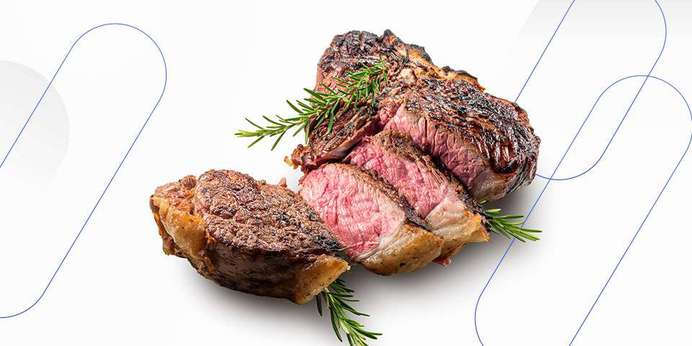
Even if your meat products are safe to eat, customers will refrain from purchasing them if their colour looks unnatural. Follow these practices to help maintain and measure the industry colour requirements for meat.

Even if your meat products are safe to eat, customers will refrain from purchasing them if their colour looks unnatural. Follow these practices to help maintain and measure the industry colour requirements for meat.
Before testing the colour of meat, you should be aware of extrinsic factors that often affect meat colour. Myoglobin is the primary intrinsic factor that gives precooked meat its red colour — however, certain extrinsic factors play a large part in the coloring. Some of the most common include:
Customers use colour to gauge meat quality or safety. To ensure your meat is up to industry standards, test it at every stage of the manufacturing process using a spectrophotometer.
A spectrophotometer is a complex instrument that creates a spectral analysis for meat colour measurements. Additionally, it can estimate the percentage of myoglobin, making it the most efficient equipment for the job.
Use the following practices for obtaining quality results with a spectrophotometer.
Meat testing requires the right amount of gentle pressure so no light can enter or exit the machine's aperture. However, make sure nothing is putting too much pressure on the sample, or this can cause the meat to form a curved surface, known as pillowing.
In general, the sample should have a flat surface for the best results. Any dent or curvature can alter the machine's reflectance and affect colour readings.
Samples 12 to 15 millimeters thick are usually the most adequate to absorb non-reflected light. If a sample is too thin, results can be swayed. Keep every sample — precooked and cooked — around the same size and structural uniformity.
If your sample is on the larger side, consider using at least three scans — especially if the sample's colour varies across the surface. The scans can then be averaged for your analysis result.
Some animal meat has two-toned areas because of pH declines and muscle fiber type. Instead of combining the results for the whole sample, treat two-toned meat as separate muscles, taking scans of each area and averaging them separately.
HunterLab offers the ColorFlex EZ spectrophotometer for quality meat colour testing, measuring colours the same way the human eyes do with precise accuracy. Learn more about this solution and reach out to us for a quote today!
HunterLab goes beyond color, delivering precise, science-backed solutions that help industries achieve superior quality and appearance control. As a global leader in spectrophotometry, we empower businesses to reduce waste, improve efficiency, and enhance product consistency—directly impacting the bottom line. By combining innovation, real-world expertise, and sustainable measurement solutions, we help manufacturers optimize production, minimize material loss, and meet the highest industry standards. Follow us on LinkedIn