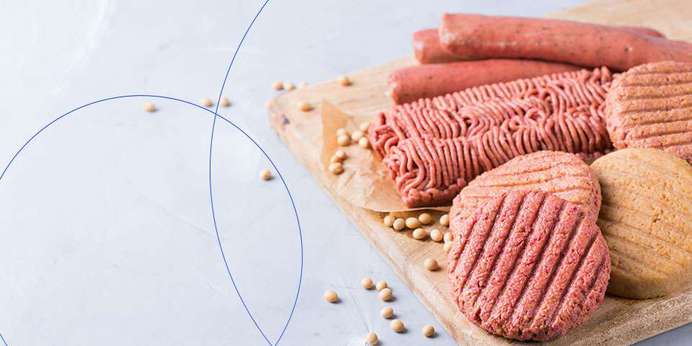
Appearance is the first factor customers judge when looking for a plant-based substitute. To help customers be more drawn to your product, measure the colour of your plant-based meat substitutes at every production stage.

Appearance is the first factor customers judge when looking for a plant-based substitute. To help customers be more drawn to your product, measure the colour of your plant-based meat substitutes at every production stage.
As knowledge of alternative proteins advances, plant-based meat substitutes are improving and becoming more common, ultimately making the manufacturing industry more competitive to produce products that look and feel like the original meat.
Overall, protein types differ in their appearance, both as raw material and when cooked. Measuring the colour of plant-based meat substitutes at this stage can help you ensure you are replicating your desired meat — beef, pork, poultry, or seafood.
Some of the most common protein substitutes that match colour patterns in plant-based products include:
Traditional meats have a high concentration of oils, fats, and binding agents, which produces their soft look and texture. Alternatively, plant-based materials have a lower concentration of these materials, which can create a crumbly texture. Mixing in additional binding ingredients — such as palm oil, sunflower oil, xanthan gum, and wheat gluten — can slightly change the colour of your meat substitute.
At this point, your meat is at the ready-to-cook stage. Before it gets to the store, your product will go through processing, packaging, and handling and be exposed to various lighting, which can all influence colour appearance.
Measure the colour of your plant-based meat immediately following its composition and display temperature tests. Your customers will likely be purchasing your product at this stage, so its appearance is vital to its sale.
Put yourself in your customers' shoes for a moment, and cook your plant-based meat to ensure it is the intended colour, shape, and texture. Measuring its colour after cooking is the final stage in safety and quality standards, ensuring your product stays attractive to the human palate throughout the process.
Many plant-based meat manufacturers use colored pictures and scoring scales to measure colour. Instead, take advantage of HunterLab's high-accuracy spectrophotometers such as the ColorFlex EZ and Aeros, designed to speed up the colour measurement process and assist with meeting best practices at each stage.
As an industry leader for over 70 years, HunterLab offers equipment that measures and reports colour testing results based on industry standards for all meat substitutes. Get a quote today!

HunterLab goes beyond color, delivering precise, science-backed solutions that help industries achieve superior quality and appearance control. As a global leader in spectrophotometry, we empower businesses to reduce waste, improve efficiency, and enhance product consistency—directly impacting the bottom line. By combining innovation, real-world expertise, and sustainable measurement solutions, we help manufacturers optimize production, minimize material loss, and meet the highest industry standards. Follow us on LinkedIn