
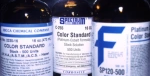
Bottles of APHA/Pt-Co/Hazen 500 colour standard.

“APHA” stands for American Public Health Association Colour Scale, the organization responsible for the original definition and implementation of this visual colour scale as a standard method for rating water quality.

What Name Should You Use?

It is also called “Pt-Co” for Platinum-Cobalt Colour as this visual colour scale is based on stable liquid colour standards made from chloroplatinate solutions. The scale ranges from distilled water at 0 (“water-white”) to a stock solution of 500 (parts per million of platinum cobalt to water). Intermediate Pt-Co colour standards are made by dilution of the Pt-Co stock solution as described in ASTM D1209.

Another name used for this same colour scale is “Hazen”, named after Allen Hazen, the chemist who first defined the colour scale for the American Public Health Association. When referenced as “Hazen Colour”, the range is often above the typical 500 units associated with the APHA/Pt-Co, as in “1500 Hazen Colour”.

“APHA”, “Pt-Co” and “Hazen” are three names for the same colour scale.

The name preferred in ASTM D1209 and ISO 6271 is the “Platinum-Cobalt Colour” or Pt-Co, but “APHA” is name in most common use in industry. When used, the term “Hazen Units” (HU) may be found in product specifications.
Read  ASTM Industrial Test Methods for visual and instrumental APHA Colour Scale

History Of The APHA/Pt-Co/Hazen Scale

The APHA/Pt-Co/Hazen Scale was originally developed in the 1890s as a visual indicator of the purity of public water supplies, where a slight yellow colour is due to the leachates of naturally occurring organic materials such as leaves, bark, roots, humus and peat. It was also used to verify the degree of contamination of waste water from manufacturing and public sewage sites in the early development of American cities.

Today, APHA/Pt-Co/Hazen Colour is used as a metric for purity in the water, chemical, oil, plastics, and pharmaceutical industries. This scale serves to quantify the appearance of trace amounts of yellowness, a visual indicator of product degradation due to exposure to light or heat; the presence of impurities and negative effects of processing.

APHA/Pt-Co/Hazen Colour Scale Regulations

FAQ: “In reviewing an EPA Waster Water discharge permit they reference PCU units.  Then footnote that these units are defined in 40 CFR 136 method 2120B.”

APHA/Pt-Co/Hazen/PCU are all names for the same visual platinum cobalt colour scale and are found in methods of about 6 organizations.

The original standards body to define APHA Colour was the American Public Health Association in APHA Method 2120 “Standard Methods for the Examination of Water and Wastewater”. There are two sections:

Section 2110 Appearance defines the distinction between colour and appearance

Section 2120 Colour which is further subdivided into:

  • Section 2120A Introduction defines the distinction between colour and turbidity.
  • Section 2120B Visual Comparison Method (equivalent to EPA Method 110.2) citing preparation of the visual liquid APHA colour standards.
  • Section 2120C Spectrophotometric Method (equivalent to EPA Method 110.3) citing an spectrophotometric correlation method to the visual APHA colour standards.
  • Section 2120D Filter Tristimulus Method citing a tristimulus correlation method to the visual APHA colour standards.
  • Section 2120E ADMI Tristimulus Filter Method (equivalent to EPA Method 110.1) citing a tristimulus correlation method for the ADMI Colour Scale using the visual APHA colour standards.
INFO  Get More Information

U.S. Environmental Protection Agency EPA Method 110.2 Colour – Colorimetric – Platinum-Cobalt is found in – “Methods for the Chemical Analysis of Water.” This EP method is the same as the APHA methods. Equivalency of the APHA-to-EPA methods are found in the U.S. Federal Registry 40 CFR Parts 136, 141, and 143.