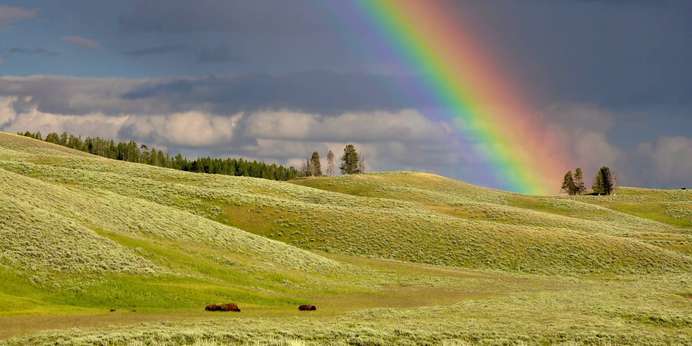
Isaac Newton conducted several studies using light, which led to the discovery of the rainbow. He found that passing white light through a prism gets refracted into many hues. White light is not white — it has the ROY G BIV sequence. In other words, the colours of our rainbow make unseen light visible. It is, therefore, apparent to the human eye.

The various wavelengths of each hue in the visible light spectrum account for the rainbow colours' arrangement, represented by the letters ROY G BIV. Thus, the longest wavelength is red, which has a wavelength of around 700 nm, and the shortest wavelength is violet, which has a wavelength of about 380 nm. As a result, as the various colours exit the prism, they fracture at a certain angle, producing a rainbow of hues.

While pioneering the concept of a light spectrum, Sir Isaac Newton divided it into seven colours, including indigo. This inclusion stemmed partly from the cultural significance of indigo as a prevalent dye at the time. Interestingly, the categorization of colour is subjective and culturally influenced, with human perception grouping a continuous spectrum into distinct bands for easier comprehension. Newton's choice of seven colours was also likely influenced by the prevailing belief in the significance of the number seven.

The seven colours of the rainbow are:

  • Red
  • Orange
  • Yellow
  • Green
  • Blue
  • Indigo
  • Violet

Each hue is distinct in terms of frequency measurements and the values and meanings that society assigns to it.

Frequency and Exact Colour Measurements of the Rainbow

Light travels in waves— its frequency is the number of wavelengths passing a given point each second—a shorter wavelength results in a higher frequency and vice versa. Humans can see light between 400 and 700 nanometers (nm) — the visible spectrum. Because each colour has a different wavelength and frequency, each light colour separates and becomes visible when passing through a prism.
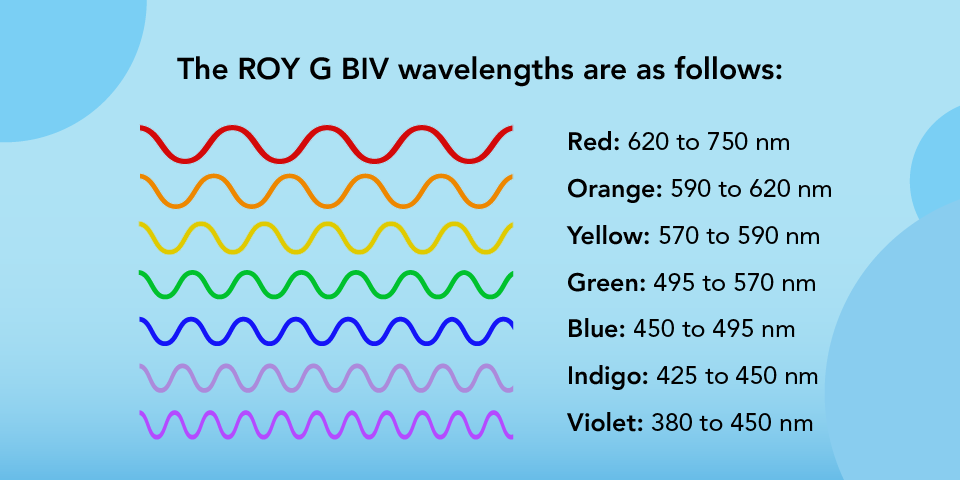
A blue background with the wavelengths for each color of the rainbow

The ROY G BIV wavelengths are as follows:

  • Violet: 380 to 450 nm
  • Blue: 450 to 495 nm
  • Green: 495 to 570 nm
  • Yellow: 570 to 590 nm
  • Orange: 590 to 620 nm
  • Red: 620 to 750 nm

What Does the Order of the Colours of the Rainbow Mean?

The rainbow's colour order is ROY G BIV. Red has the lowest frequency at the top of the arc, and violet has the highest frequency at the bottom. When light passes through a prism, it refracts the different colours in the same order because each wavelength bends at a unique angle.

Though the order of the colours will always be the same, the way the spectrum is defined has changed over time. 

Read  RGB v Tristimulus Colour Scales – HELP!

Meanings of the Colours of the Rainbow

Cultural and personal experiences give colours their meaning. Each colour has different feelings and images associated with it.

Red

Red is a passionate colour associated with both violence and love. This hue is deeply connected to the human experience as the colour of fire and blood. It also has a physical effect — red increases metabolism, respiration rates, and blood pressure. The primary raw material for red dye is cochineal insects.

Orange

Orange is a secondary colour that occurs when combining red and yellow. Orange is a vibrant colour associated with the autumn season, so the colour symbolizes movement and change. It's also the colour of creativity. Orange was common in ancient art and is sacred in many cultures. The dye comes from natural resources like carrots and turmeric.

Yellow

Yellow is a bright, energetic colour connected to light and sunshine. The colour evokes cheerful, happy moods, prompting celebration. Yellow is also said to help clear the mind for decision-making. It is a symbol of wisdom. It is one of the oldest colours in history and represents the sun gods. Raw materials for yellow dye are dandelions, celery, and other natural sources.

Green

Green is a secondary hue formed by combining blue and yellow. Green is the colour of the earth, embodying growth, renewal, and abundance. This hue has blue's calmness and yellow's energy, resulting in a balanced, harmonious colour. Initially, materials for manufacturing green pigments used toxic chemicals, but safe alternatives, including mint and grass, are available today.

Blue

Blue represents security, peace, and calmness. It also exudes confidence, authority, and responsibility. In the English language, the colour has some connotations with sadness. Synthetic indigo is today's most common source of blue dye.

Indigo

This hue portrays a link between the finite and the infinite. Because it is more vibrant than blue, this hue exudes enthusiasm. Indigo is a sign of intelligence, self-control, intuition, and eternity. Indigo occurs naturally from the leaves of many plant species, such as indigo, woad, and polygonum.

Violet

Purple was first made from snails in a time-consuming, expensive process, so it is associated with royalty and wealth. The colour also symbolizes creativity and imagination. Today, the purple dye comes from cochineal insects.

INFO  Get More Information

Contact HunterLab Today

For more than 65 years, HunterLab has been an innovator in colour science, working to accurately measure colours using spectrophotometer technology. We help companies in all industries ensure that their product appearance is precise and consistent. For more information about our services, contact us today.