The human eye is a truly remarkable and intricately designed system. A healthy eye has millions of retinal photoreceptors in the form of rods and cones, allowing us to translate light into colour. As a result, most of us are able to see at least a million different colours, with some experts maintaining that the true number is as high as high as 10 million.1 This astounding perceptive ability is surpassed by few species in the natural world and suggests that colour vision has conferred important evolutionary benefits for humans, perhaps explaining why we have developed such strong emotional associations with and preferences for certain hues. However, congenital or acquired damage to any component within the delicate optical apparatus can impair your ability to accurately perceive colour and there are a number of inherited disorders, diseases, and medications known to interfere with colour vision.
01-Understanding-Color-Vision-Impairment-and-the-Need-for-Objective-Color-Measurement.png

Inherited Colour Vision Disorders

Most colour vision impairment is the result of inherited colour vision disorders that arise due to abnormal photoreceptor cell function, including:

Red-Green Colour Blindness

Red-green colour blindness is a sex-linked trait and by far the most common colour vision disorder, affecting up to 8% of men and 0.5% of women. This type of colour blindness results from missing or damaged L-cones (protanopia or protanomaly) or missing or damaged M-cones (deuteranopia or deuteranomaly), creating difficulties distinguishing between reds and greens as well as blues and greens, grays and purples.

Blue-Yellow Colour Blindness

Blue-yellow colour blindness is far rarer than red-green colour blindness, representing fewer than 1 in 10,000 people with colour vision disorders, and is not sex-linked, meaning men and women are affected equally.

This condition can either take the form of tritanopia, in which S-cones are completely missing, or tritanomaly, in which S-cones are present but damaged. Blue-yellow colour blindness can be a misleading name, as the disorder does not create difficulties distinguishing between blues and yellows, but rather, causes those with the disorder to confuse yellow with violet and blue with green.

Achromatopsia

Achromatopsia is a hereditary disorder that results from abnormal cone function, significantly reducing or eliminating your ability to see colour. Unlike what is typically called colour blindness, achromatopsia is rare, affecting between 1 in 30,000 and 1 in 50,000 people, and involves a complete or near-complete lack of colour vision; in the most severe cases, you see only shades of white, black and grey.

In addition to impaired colour perception, achromatopsia causes a number of additional vision problems, including involuntary eye movements, low visual acuity and increased light sensitivity.

Cone-Rod Dystrophy

Cone-rod dystrophy is an inherited disease that damages light-sensitive cells in the retina, impairing vision sharpness, peripheral vision, and colour perception in an estimated 1 in 40,000 people. In some cases, colour vision impairment is present at birth. In other cases, photoreceptors deteriorate over time to progressively impede colour perception.
pexels-photo-large (8).jpg

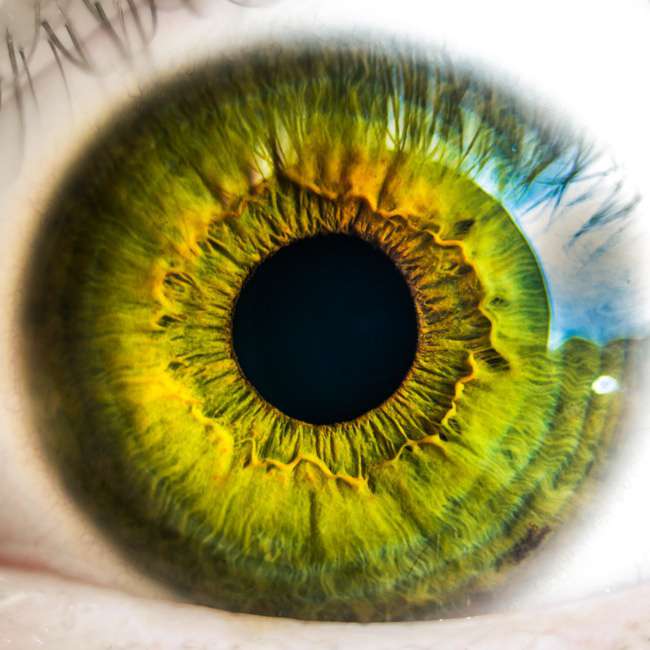
A number of health conditions can damage eye tissue and create colour vision changes. Image Source: Pexels user Tomasz Bazylinski

Read  Temperature Effects on Colour Measurement: Maintaining Accuracy in Extreme Conditions

Diseases

There are a number of congenital and acquired diseases that compromise the ability to see and/or recognize colours due to ocular damage, including:

  • Cataract: A cataract is a progressive hardening, yellowing and cloudiness of the eye’s normally transparent lens, which reduces your ability to perceive both contrast and colour as your vision takes on a yellow or brownish tint. Cataracts are perhaps the most common cause of colour perception impairment, affecting approximately 50% of Americansby age 80. In some cases, cataracts can begin developing significantly earlier, particularly those types that result from health conditions such as diabetes.
  • Diabetes: Diabetes can have a profound impact on eye function and is the primary cause of blindness in American adults. The disease can also disrupt your ability to perceive colour, particularly on the blue-yellow axis, and colour vision may fluctuate with sugar levels.
  • Glaucoma: Glaucoma is an umbrella term encompassing a number of eye conditions resulting in optic nerve damage. Many people with glaucoma experience difficulty distinguishing between colours, and colour perception impairment is often one of the first symptoms of the illness.
  • Macular degeneration: Damage to the macula—the part of the retina that facilitates sharp, central vision—can result in a variety of visual impairments, including reduced photostress responsiveness, blurred vision, and reduced colour recognition. Specifically, your ability to distinguish between similar shades is compromised.
  • Alcoholism: Chronic alcohol abuse is known to produce ocular changes that impair colour vision. Researchers believe that these changes may primarily affect the blue-yellow axis, although some alcohol-related dyschromatopsia includes red-green colour vision loss as well. Most research on the effects of alcohol on colour vision has concentrated on those with sustained, long-term histories of alcohol abuse, but a recent study on young alcohol consumers without histories of alcoholism suggests that even casual drinking amongst adolescents and young adults may result in subclinical colour vision losses.
02-Medications.png
INFO  Get More Information

Medications

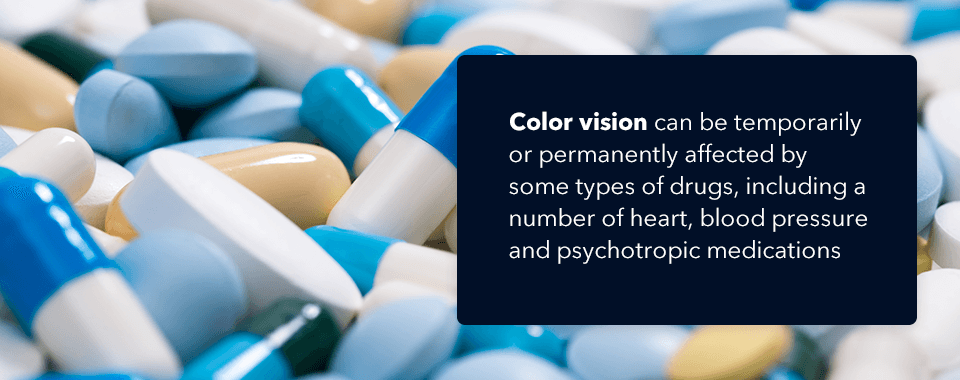
Colour vision can be temporarily or permanently affected by some types of drugs, including a number of heart, blood pressure, and psychotropic medications:

  • Lorazepam: Lorazepam, also known as Ativan, is a benzodiazepine used to treat symptoms of anxiety, and can cause colour vision disturbances such as diminished ability to perceive colour.
  • Viagra: Viagra, an erectile dysfunction medication, can result in “a blue tinting of the vision, known as cyanopsia” in the hours following drug intake. This effect has been observed in up to half of users and is temporary, allowing your vision to return to normal after use.
  • Digoxin: Digoxin is a drug used to treat congestive heart failure as well as atrial fibrillation and can result in yellow colored vision as well as a range of other optical disturbances that may decrease accurate colour perception.
  • Gilenya: Gilenya is a relatively new medication used to treat multiple sclerosis and may produce changes in colour vision, including tinting.
  • Hydroxychloroquine: Hydroxychloroquine is an antimalarial drug also used to treat a variety of health conditions, including rheumatoid arthritis, systemic lupus erythematosus, and discoid. Long-term use may lead to retinal damage that creates colour vision impairment, including difficulty distinguishing between colours.

Is Colour Subjective or Objective?

While the physical properties of light may stay the same, human colour perception can vary depending on whether or not a person has colour blindness. A colour’s visual evaluation is approximate and subjective. However, colours have objective properties that can be measured by an instrument. Spectrophotometric instruments provide precise results in correlation with human perception.

In short, light has objective, measurable properties, but your perception of colour is subjective. If you have colour blindness, you can view the same object as someone else but perceive it as a different colour.

Towards Objective Colour Assessment

While the human eye is a finely designed instrument of extraordinary complexity, it is also a highly vulnerable to compromised colour perception due to biological, social, and environmental influences. As such, visual assessment of critical chromatic information is inherently unreliable, potentially resulting in the release of defective and inconsistently colored products.

Today’s sophisticated spectrophotometric instruments provide precise, accurate, and repeatable colour measurements to ensure correct coloration of all types of materials using a range of optical geometries that can both replicate perfect human vision and go beyond the limits of the human eye. By using spectrophotometers to assess colour through research and development stages or integrating spectrophotometric instrumentation within your production line, you can be sure that colour is measured the same way every time, regardless of operator or location. The objective data provided by these advanced colour measurement technologies allows you to easily share relevant colour information throughout your supply chain, creating a universal language of colour that cuts across culture, biology, and environment and does not depend on individual perceptive ability.

Speak With an Expert From HunterLab About Your Colour Measurement Needs

Spectrophotometric instruments provide clear, objective colour data. At HunterLab, we have been pioneers in the field of colour analysis for more than 60 years. Our versatile range of portable, benchtop and inline spectrophotometric instruments is used across industries to supply the critical colour information necessary to ensure quality and enhance efficiency.

By combining the power of spectrophotometry with user-friendly software packages, you can unlock the true potential of colour and experience the ultimate in colour quality control. Contact us for more information about our products or to speak with us about your colour measurement needs.