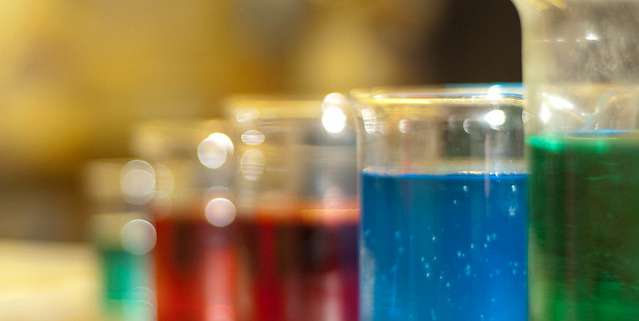
The commercial beverage industry utilizes food dye additives to create a rainbow of colour choices which appeal to today’s market. Image Source: Flickr’ user The Kingsway School

This past weekend marked the end of my youngest son’s recreational basketball league and like most youth sports teams, we headed to our local pizza parlor to celebrate. Of course with the free range soda fountain, the ever popular “graveyard” soda pick was popularized that evening by none other than my own 8-year-old son. To those of you who are uneducated in the “graveyard” refreshment, it consists of a random selection of all soda fountain choices that when combine create a unique taste and colour sensation. As I watched him mix his drink creation, I noticed that the selections have greatly expanded since the original “graveyard” beverage choices from my youth. Not only have the flavor choices expanded, but thanks to the analysis of food dyes in beverages, there are now many more vivid colour choices available as well.

From bright colored soda flavors to multi-colored sports drinks and even flavored spirits, today’s beverage colour selections have far exceeded the normal range of hues. Not only do the unique flavor combinations help sell the product, but the analysis of food dyes in beverages also play an important role in product formulation. With only a limited number of dyes approved by the Food and Drug Administration for use in foods, commercial beverage manufacturers must rely on only seven FD&C dyes to create the entire palette of artificial food colours to formulate the many colour choices in today’s liquid refreshment selections1. Spectrophotometers offer a simple yet effective tool needed to maintain colour consistency and quality in commercial beverages and can simplify the formulation process by quantifying and storing this information for batch-to-batch repeatability.

Read  Beer Colour Analysis: Setting the Standards for Quality Using Spectrophotometric Technology

A Better Understanding of Colour Measurement

Colour measurement varies based on sample type and purpose. The analysis of food dyes in beverages requires specific measurement techniques that are dependent on the sample type and transparency value of the liquid. Colour appeal and consistency are critical when factoring in consumer choice and product acceptance. Quantifying colour intensity is the first step for proper formulation and desired colour outcomes.

Spectrophotometers allow for the most precise colour measurements. Understanding your spectrophotometer and the unique sample variations can ensure that analysis of food dyes in beverages are accurately quantified for colour quality and repeatability.

In a food dye lab, spectrophotometers allow developers to quantitatively measure their combined usage of the seven FDA-approved dyes. The spectrophotometer does so with a light source divided into its distinct wavelengths. Colours absorb and transmit these wavelengths to different degrees.

When the light source hits a cuvette of the dye mixture, it will use a sensor to measure the absorbance and transmittance of the different wavelengths. The spectrophotometer inputs this data into a chart for developers to assess. While colour is often thought of as a subjective trait, spectrophotometry gives a definitive value for colour in beverage development.

With stringent regulations for developing beverages, spectrophotometers are the key to measuring colour and developing a consistent product. Through the analysis of food dyes in a beverages lab, developers can trust their colour choices for every product, rather than relying on perception alone.

16942861038_cd429d6be8_z.jpg

Understanding the proper colour measurement techniques need for various beverages ensures that proper formulation and additives are used effectively to maintain quality. Image Source: Flickr’ user iggyshoot

INFO  Get More Information

Using Colour Data for Formulation and Repeatability

Consistency is essential for consumer acceptance and quality control. Even slight changes or alterations in colour formulations can hinder perceived quality. When developing a specific colour formulation, it is important to quantify colour changes in relation to food dye additives. This data can then be stored and duplicated from batch to batch and can be transferred to various processing plants without the need for visual comparison. Since even slight colour changes can indicate poor quality or unsafe food products, beverage colour must be closely monitored to uphold the brand reputation and quality.

Spectrophotometers offer the ability to monitor colour additives continually and help develop a colour averaging system. Repeated data can then be used to set colour standards necessary for formulation and prompt any needed changes. Using real-time colour analysis allows for any colour variations to be noticed quickly and formulation changes to be addressed in a timely manner, decreasing any wasted resources and improving the profit margin.

Colour Quality and Consumer Acceptance

Although taste is an important factor in beverage marketability, many studies show that the visual appeal of beverages has an even greater effect on consumer choice2. With products lined up on shelves, colour variation between one product and the next can be obvious. Colour consistency is critical for earning customer approval. Instrumental analysis of food dyes in beverages ensures that both quality and visual recognition are maintained no matter where a product is manufactured or who is performing the colour evaluation. Advanced spectrophotometers take the guess work out colour formulations and are both simple and easy to use.

9569632278_44fea790d0_z.jpg

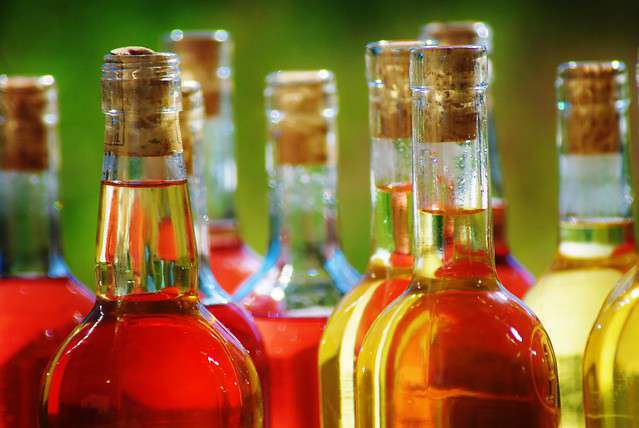
Many leading commercial beverage manufacturers rely on advanced spectrophotometers to ensure both quality and consumer appeal. Image Source: Flickr’ user J. Triepke

At HunterLab we offer state of the art colour measurement instrumentation that is backed by our friendly and knowledgeable support team. We work hard to make sure that you choose the right tool for the job and offer continued support to ensure that you are able to utilize your spectrophotometer to its full potential. For this application, we recommend using the VISTA Spectrophotometer. Unlike typical UV/Vis instruments, the VISTA uses a myriad of sample cells ranging from 1 cm – 5 cm pathlengths and continuous flowthrough cells. HunterLab spectrophotometers are trusted by many of today’s beverage industry leaders to offer the functionality and accuracy needed for colour quality. For more information on our line of spectrophotometers designed for beverage colour analysis, contact HunterLab today.