
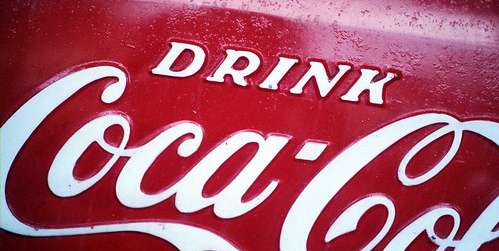
The iconic white and red ribbons of Coca-Colour is perhaps the most successful example of logo branding in history. Image Source: Flickr user Steve Snodgrass

When I think of iconic brands, the first thing I imagine is their logo. More specifically, I imagine their logo colour—the white and red swirls of Coca-Cola, yellow arches of McDonald’s, the gold crown of Rolex, the simple blue square of Facebook. Logo colours speak to us, telling us a story about the brand, about values, and about identity. Tangerine’s distinctive orange, for example, sets it apart from the blues, greens, grays, and blacks of more traditional financial institutions, suggesting a youthful energy while paying homage to its Dutch roots. The Starbucks logo was originally brown, but when the company merged with Il Giornale they dropped the “tradition-bound” hue for a more “affirming” green.1 Some colours become so deeply connected to the identity of a brand that merely a glimpse of the hue calls to mind the rich history of company. The robin’s egg blue that serves as the background for Tiffany’s name printed in plain black has become so intrinsically linked to the brand that it is now known all over the world as Tiffany Blue, symbolizing “elegance and exclusivity.”2

Brands are increasingly coming to understand the importance of sensory marketing, with many investing in methods that appeal to consumers’ bodily sensations to make vital connections between emotions and products. The power of colour, in particular, to draw customers is well-documented: 84.7% of consumers say that colour is their primary reason for buying a particular product and 80% believe that colour increases brand recognition.3 The importance of colour extends not just to the product itself, but to the logo, whether it is incorporated within the product, packaging, retail environments, websites, or in advertisements. In fact, the logo may be more powerful than any single product, as it stands in for the company as a whole and sets the mood for consumer encounters across media. By drawing on our pre-existing psychological lexicon, colour can be deployed to invite particular reactions and inform relationships with consumers, acting as chromatic symbols of a brand’s priorities and behaviors from the first glance. As such, market researchers and designers spend considerable time, effort, and often money finding the perfect hue to represent their brand and project their desired image into the world.

pexels-photo-large (9).jpg

The distinctive Starbucks logo is so firmly associated with the company that we can immediately identify the brand with only a glimpse. Image Source: Pexels user Adrianna Calvo


Read  Temperature Effects on Colour Measurement: Maintaining Accuracy in Extreme Conditions

Logo Colour and Consumer Perception

However, logo colour can do more than simply shape consumer expectations of potential company behavior; it can alter how actual company behavior is perceived. A study published in the Journal of Business Ethics examined the impact of logo colour on assumptions of company values as well as perception of corporate business practices.4 In the first part of the study, research subjects were shown a fictitious logo in varying hues and asked to identify which logo projected an image of eco-consciousness. While green was a popular choice, blue was the most strongly associated with environmentalism “despite the frequent use of the word ‘green’ to convey that idea.” Once the researchers determined which colours were perceived as environmentally friendly, they designed a second experiment:

Respondents were asked to share whether a fictitious retailer, DAVY Grocery Store, acted ethically in various morally ambiguous scenarios, such as spraying water on produce. Subjects only saw the logo for DAVY, which was presented in either an eco-friendly colour or an unfriendly colour.

This is where the study truly became exciting. The researchers found that logo colour had a significant impact on the respondents’ perception of DAVY’s behavior; when the grocery store was represented through an eco-friendly logo such as blue or green, the ethically ambiguous scenarios were more likely to be regarded as ethical. In other words, while logo colour shaped consumer perception of the company’s ethics prior to knowledge of the company’s practices, that perception then became the lens through which company practices were viewed regardless of the company’s actual intent. As such, colour appears to serve an even more powerful role than previously realized

pexels-photo-large (10).jpg

Once a logo colour has been chosen, reproducing your trademark hue across media and materials is critical to strengthening brand identity. Image Source: Pexels user Roman Pohorecki

INFO  Get More Information

Bolstering Brand Identity Through Colour Measurement

When your company has selected the ideal colour scheme for your logo, fortifying the connection between your brand and your logo colour requires consistent and accurate reproduction of that colour across media and materials. Not only does colour harmony amongst disparate logo appearances create a visually pleasing effect, it also strengthens brand recognition and encourages consumers to build a visual relationship with your company. HunterLab spectrophotometric instrumentation offers for precise measurement of colour within all types of surfaces, from paper to metal, textiles to plastics, glossy to matte, making it possible to create perfect colour matches, ensure consistency, and overcome colour matching challenges. By replacing subjective visual assessment, spectrophotometric analysis can act as a common language that allows your logo colours to be reproduced across multiple locations anywhere in the world with remarkable ease and accuracy. Hunterlab’s lineup of sophisticated, user-friendly spectrophotometers is ideally suited for a broad range of applications, whether you require continuous monitoring of logo colour within a production line or one-off measurements in an office space. Together, we can work to bring your brand identity to the next level. Contact us for more information about our innovative technologies, advanced software packages, and dedicated customer service supports.