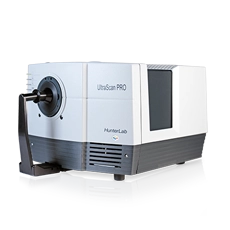
UltraScan PRO
Your reference instrument for measuring both reflected and transmitted colour, from near ultraviolet to near infrared.
Learn More

Is subjective visual colour inspection putting your batch release, pharmacopeial compliance, and data integrity at risk?
In pharmaceutical and biotech production, the appearance of a drug substance, drug product, biosimilars, biologics and excipients is a direct, quantifiable indicator of chemical state. Instrumental colour measurement converts that indicator into objective data (L*, a*, b* values, ΔE* differences, and pharmacopeial colour indices) that replace subjective visual checks across R&D, formulation, stability, scale-up, and release QC.
Pharmacopeial colour and turbidity/opalescence tests for liquid drug products and APIs have traditionally relied on an analyst comparing a sample to reference solutions by eye. In a modern GMP environment, that approach introduces risk at every step:
HunterLab pioneered instrumental colour measurement for bio-pharma products and offers a family of spectrophotometers built for compliance and versatility. Spectrophotometric analysis handles transparent samples (clear liquid solutions measured in a cuvette in transmission) and opaque samples (powders, tablets, and capsules measured in reflectance). HunterLab systems switch between reflectance, transmission, and turbidity / opalescence in a single device, and many are preloaded with EP, USP, JP, and CP color and turbidity methods, so a complex pharmacopeial test becomes a push-button routine.
Understanding the numbers: these instruments report colour in the CIE L*a*b* colour space: L* for lightness (0 = black, 100 = white), a* for the red–green axis, and b* for the yellow–blue axis. ΔE* expresses the total colour difference between a sample and its target, so a single number can flag when a batch has drifted out of specification.
Your reference instrument for measuring both reflected and transmitted colour, from near ultraviolet to near infrared.
Measure the full range of reflected and transmitted human colour perception in this high-performance colour measurement spectrophotometer/colorimeter.
Level up your clarity and colour confidence with Vista® L2 — measure colour and haze in one step with a modern smart interface, a spill resistant sample compartment and built-in PC power and storage.
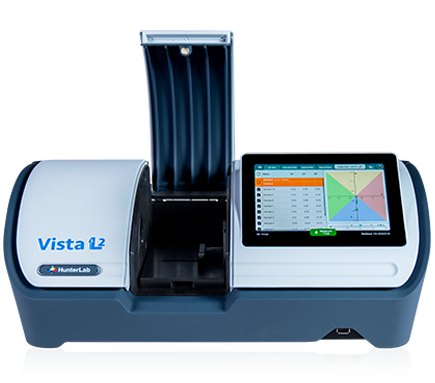
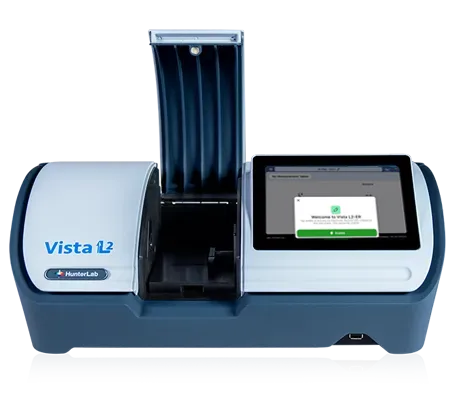
Level up your clarity and colour confidence with Vista® L2 — measure colour and haze in one step with a modern smart interface, a spill resistant sample compartment and built-in PC power and storage.
Level UP your Colour Confidence with the Agera L2, now enhanced with Essentials L2 software, advanced illumination modes, a sealed spillproof case, stellar product updates and so powerful that no PC is required.
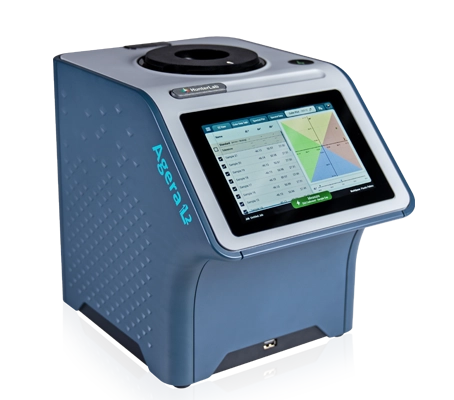
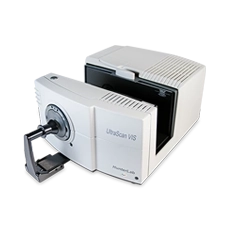
Four HunterLab instruments cover the full range of bio-pharma applications, from research-grade liquid analysis to routine solid-dosage QC. Each instrument supports ER software configurations for 21 CFR Part 11 compliance workflows, including Essentials L2-ER with Quality Central-ER or EZMQC-ER. A Validation and Compliance Notebook is available to support instrument qualification and compliance documentation.
| Features | HunterLab UltraScan PRO | HunterLab UltraScan VIS | HunterLab Vista L2 | HunterLab Agera L2 |
|---|---|---|---|---|
| Spectral range / interval | 350–1050 nm, 5 nm | 360–780 nm, 10 nm | 400-710 nm, 10nm | 400-700 nm, 10nm |
| Geometry / optics | Diffuse d/8° reflectance, d/8° total transmission, d/0° regular transmission | Diffuse d/8° reflectance, d/8° total transmission, d/0° regular transmission | Tt/0º or Td/0º transmission per ASTM 1164, CIE 15:2018 | 0°/45°c (circumferential) reflectance ASTM E1164 |
| Measurement modes | Reflectance, transmission, haze (turbidity) | Reflectance, transmission, haze (turbidity) | Transmission colour, haze (turbidity) | Reflectance, 60º gloss |
| Best-fit samples | Liquids, powders, tablets; UV-range and NIR materials | Liquid solutions, powders, tablets, capsules, UV -range materials | Transmission colour & haze/turbidity of liquids and solids | Tablets, pills, capsules, caplets |
| Key compliance | USP <1061>, EP 2.2.2 (Method I), EP 2.2.1, ASTM E313, ASTM D1003, ASTM D1209 | USP <1061>, EP 2.2.2 (Method I), EP 2.2.1, ASTM E313, ASTM D1003, ASTM D1209 | USP <1061>, EP 2.2.2 (Method I), EP 2.2.1, ASTM E313, ASTM D1003, ASTM D1209 | USP <1061>, ASTM E313 |
| Software & data integrity | EZMQC-ER | EZMQC-ER | Essentials L2-ER with EasyMatch Quality Central-ER; 32 GB onboard storage | Essentials L2-ER with Easy Match Quality Central-ER; 32 GB onboard storage |
| Standout benefit | Research-grade accuracy with 5nm reporting interval and extended UV–NIR range and multi-mode flexibility | Full CIE visible range plus full preloaded pharmacopeial colour & turbidity libraries | Standalone benchtop; simultaneous colour and turbidity measurement in a single measurement; built-in wavelength verification standard; 32 GB storage; upgrades without retraining or revalidation | Certified Grade ‘A’ CIE D65 source illumination; Reference-grade 0°/45°; Dark Performance Mode improves accuracy for low-reflectance materials; largest measurement area. |
| Colour Scales & Indices | CIE L*a*b*, Hunter Lab, EP/USP/CP/JP pharmacopeial colour indices, EP opalescence, and NTU turbidity E313 Whiteness Index, E313 Yellowness | CIE L*a*b*, Hunter Lab, EP/USP/CP/JP pharmacopeial colour indices, EP opalescence, and NTU turbidity E313 Whiteness Index, E313 Yellowness | CIE L*a*b*, Hunter Lab, EP/USP/CP/JP pharmacopeial colour indices, EP opalescence, and NTU turbidity. | CIE L*a*b*, Hunter Lab, E313 Whiteness Index, E313 Yellowness |
HunterLab is the pioneer in colour and appearance measurement for bio-pharma, with more than 20 years supplying analytical colour spectrophotometers and optimized sample-handling accessories to the global industry. HunterLab was the first analytical colour spectrophotometer system to replace visual methods, the first to report exact EP and USP values conforming to their pharmacopeial methods, the first software for 21 CFR Part 11 compliance with colour data, and the first instrument to be listed in USP Method <1061>, and today has the most global installations and the most citations in the medical literature.
Few colour measurement device vendors address pharma colour QC as comprehensively as HunterLab. The table below compares HunterLab against the alternatives bio-pharma labs commonly evaluate:
| Capability | HunterLab | Typical alternatives |
|---|---|---|
| Reflectance + transmission + turbidity in one device | Available across selected HunterLab instrument configurations | Most measure only transmittance or only turbidity |
| Built-in EP/USP/JP/CP colour & turbidity libraries | Available on applicable transmittance-capable instruments. | Generic UV-Vis and simple colorimeters are not preloaded with pharmacopeial indices |
| Reports nearest EP/USP standard | Automatic, push-button | Often missing; requires custom calibration and interpretation |
| Measures powders, tablets & capsules natively | Dedicated solid-sample geometry | Colorimeters often fixed at 10/20 mm pathlength with no solids support |
| Color-optimized optics | Stray-light suppressed; dual-beam stability | UV-Vis prioritizes wavelength flexibility over colorimetric precision |
| Validation & 21 CFR Part 11 (EZMQC/ER, IQ/OQ/PQ) | Full documentation and validated software | Limited or absent on general-purpose instruments |
| Small-sample, nondestructive testing | Can measure variable pathlengths and as little as 0.4-10 mm for liquid samples; preserves costly biologics/APIs | Larger volumes typically required; not optimized for pharma |
Use an instrumental spectrophotometer that reports CIE L*, a*, b* and ΔE* values instead of matching by eye. Clear and coloured liquids are measured in transmission using a 10 mm cuvette; opaque powders, tablets, and capsules are measured in reflectance. HunterLab instruments automate the reading and compare each result against pharmacopeial colour and turbidity standards, returning objective, reproducible data.
It depends on your sample type and the breadth of methods you run:
A colour spectrophotometer is built to quantify colour and verify consistency against standards, while a UV-Vis spectrophotometer is built to measure absorbance at individual wavelengths to determine concentration or molecular structure. colour spectrophotometers measure reflectance or transmittance across the visible range, apply CIE illuminant and observer settings to match how the human eye sees colour, and are fast, often a few seconds or less. UV-Vis instruments offer high wavelength resolution but have no illuminant/observer concept and are generally slower. The two can be complementary when a sample needs both colour and concentration data.
HunterLab instruments implement the major global pharmacopeial and industry methods in one system:
Yes. Both USP <1061> and EP 2.2.2 (Method III) explicitly permit instrumental CIE colorimetry in place of the visual method, provided the method is validated. The instrument reports CIE L*a*b* values and the nearest EP or USP colour index (for example, “EP Y2”) together with ΔE*. To qualify, follow the prescribed cell pathlength (10 mm for EP), illuminant/observer combination (D65/10° or C/2°), and wavelength interval (often 10 nm), and support the method with calibration records, SOPs, and performance checks for full regulatory acceptance.
HunterLab’s EZMQC / Electronic Recordkeeping and EasyMatch Essentials L2-ER software provide secure logins, encrypted audit trails, locked raw spectral data, and non-editable archiving, the electronic-records controls required by 21 CFR Part 11 and aligned with EU GMP Annex 11. Reports automatically log date and time, operator ID, instrument ID, electronic signature status, method (the EP or USP chapter used), the raw spectrum, computed values, and a pass/fail verdict, replacing handwritten colour observations. Validation packages (IQ/OQ/PQ) are available to support qualification.
A colour shift is an early, quantifiable warning of a quality issue. Increasing yellowness often indicates oxidation or chemical degradation; a stray tint can point to impurities or off-spec raw materials; rising turbidity in injectables can signal microbial contamination; colour streaks in solid dosage forms indicate poor blend uniformity; and a slight mismatch can flag counterfeit or substandard product. Tracking the b* (yellowness) value or ΔE* across a stability study quantifies the rate of degradation and correlates with shelf-life, letting you act before a batch reaches release.
For clear protein and biologic solutions measured in transmission, the UltraScan PRO or UltraScan VIS is the strongest fit. Both measure transmission colour and turbidity/opalescence in a single unit, conform to USP <1061> and EP 2.2.2 and 2.2.1, and need as little as 600 microliters, which preserves costly biologics and APIs during testing. A shift toward yellow in a concentrated protein solution or gene-therapy vector can indicate degradation or process variation, so tracking b* or ΔE* over time is useful. Choose UltraScan PRO when you also need the extended UV to near-IR range; choose Vista L2 for routine transmission colour and clarity checks.
Measure them in reflectance mode. Present API or excipient powders or blends in a sample cup and read directly. Tablets or coating surfaces can be measured directly or also in sample cup. The instrument reports CIE L*, a*, b* values, so a uniform reading confirms a homogeneous blend, and consistent coating colour confirms the correct shade against a target standard. Measuring the L* of a powder blend or tablet coating quantifies quality. UltraScan PRO, UltraScan VIS, and Agera L2 all handle these solid samples, with UltraScan VIS and UltraScan PRO (diffuse/8 degree integrating sphere) and Agera L2 (0 degree/45 degree geometry) offering dedicated tablet and capsule holders for repeatable, auditable measurement.
Replace subjective visual colour tests with objective, validated, audit-ready measurement. Book your demo to see how HunterLab’s UltraScan PRO, UltraScan VIS, Vista L2, and Agera L2 fit your pharmacopeial methods and GMP workflow.