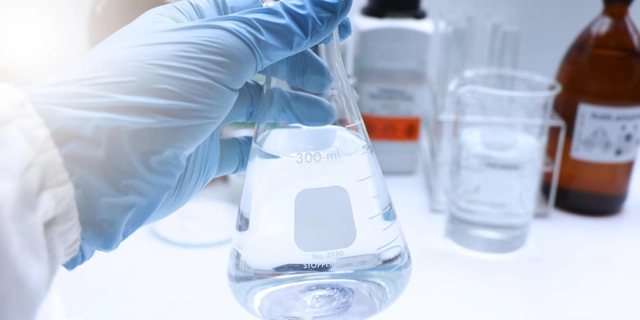
A global chemical manufacturer needed more consistent APHA color measurement for phthalic acid anhydride. The team wanted to replace subjective visual APHA grading with an objective method that could scale across sites. The product behavior added pressure. Phthalic acid anhydride melts near 130 °C and is optically clear only for a short time before it recrystallizes. The customer assumed a heated setup would be required at the instrument to keep samples molten long enough to measure.
HunterLab helped the manufacturer shift from visual estimation to seconds-fast, transmittance-based haze measurement using a transmittance spectrophotometer. The method fit the customer’s existing workflow and removed the need for heated measurement hardware at the instrument.
The Challenge: Subjective Visual APHA Testing and a Short Molten Window
The manufacturer had been determining APHA values visually. Operators compared molten samples to reference standards and recorded the closest match. That approach created issues the team could not ignore.
- Subjective decisions varied from person to person
- Results drifted across shifts and locations
- Borderline lots triggered repeat checks and delays
- Documentation was harder to defend during internal reviews or customer questions
The sample itself made improvement difficult. Phthalic acid anhydride forms a clear molten liquid suitable for transmittance measurement, then recrystallizes as it cools. Once crystals form, the sample becomes optically non-uniform and transmittance readings can become unstable.
To work around that, the customer believed the lab would need a heated measurement station. That raised concerns.
- Added safety risk near routine QC handling
- More training and controls
- More maintenance and validation work
- Slower throughput during busy production periods
The customer wanted objective APHA color measurement with a practical workflow for daily QC.
The Goal: Objective Hazen Scale Results Without Adding Process Burden
The manufacturer defined success in clear terms.
- Replace visual APHA grading with instrument-based APHA color measurement
- Capture results fast enough to measure before recrystallization
- Avoid a heated measurement fixture at the instrument
- Keep sample handling aligned with existing lab practice
- Support repeatable results across lab and plant environments
The HunterLab Approach: Prove Speed First, Then Fit Workflow
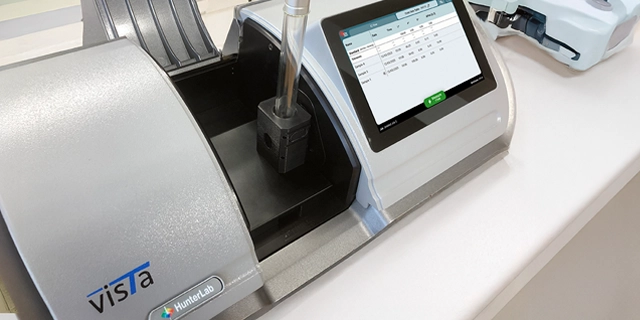
HunterLab introduced the Vista® transmittance spectrophotometer as a fast, objective platform for APHA color measurement. The key was not a complex accessory. The key was measurement speed.
INFO Get More Information
Seconds-fast transmittance APHA measurement
HunterLab demonstrated that Vista completes a transmittance APHA color measurement in just a few seconds. That timing fit inside the clear molten window, before recrystallization could affect the sample.
This result changed the project direction. The customer no longer needed a heating element at the instrument. The sample stayed molten and optically clear long enough to measure, then the operator could continue with normal handling.
Keep the sample containers the customer already used
The manufacturer already used glass tubes to melt phthalic acid anhydride. HunterLab aligned the method to that workflow. Vista supports widely used vial formats, including 24 mm vials common in petrochemical labs and ISO vial sizes. The lab could use existing tubes and containers directly, without adding new consumables or custom hardware.
That detail reduced friction for rollout across multiple sites. Standard containers are easier to source, easier to train on, and easier to keep consistent.
Make it workable in QC labs and production environments
HunterLab positioned the solution for routine use, not special-case testing. Instrument-based APHA color measurement supports consistent Hazen scale results by removing variables common in visual grading, such as ambient lighting and operator interpretation. The manufacturer gained numeric outputs suited for trend charts, internal reviews, and audit trails.
The Results: Repeatable APHA Color Measurement Without Heated Hardware
HunterLab helped the customer transition from subjective visual APHA testing to objective APHA color measurement using a transmittance spectrophotometer. The manufacturer improved repeatability and reduced process burden at the same time.
Outcomes included:
- Eliminated subjective visual APHA testing
- Replaced estimation with objective, instrument-based APHA color measurement
- No heating element required during measurement, reducing complexity and safety concerns
- Seconds-fast transmittance measurement captured before recrystallization
- Seamless integration using existing customer glass tubes
- Consistent, repeatable Hazen scale results in lab and plant environments
Why It Worked: Match the Method to the Material
Phthalic acid anhydride is measurable in transmittance when it is molten and clear. The challenge is the short window before recrystallization. Instead of adding a heated measurement fixture, HunterLabshowed the customer a faster path. Measure quickly, while the sample is still optically stable.
That single change reduced risk, simplified the station, and kept the workflow practical for daily QC.
Why HunterLab
HunterLab combines application knowledge with measurement expertise, then fits the method to real lab constraints. In this project, HunterLab delivered value by focusing on what mattered most to the customer’s QC team.
- Understood the material behavior and recrystallization timing
- Used a transmittance spectrophotometer to produce objective APHA color measurement
- Proved that seconds-fast measurement removed the need for heated hardware at the instrument
- Supported common vial formats so the customer could keep existing glass tubes and practices
Ready to Improve Chemical Color Control?
Discover how HunterLab solutions deliver objective, repeatable color data for even the most challenging chemical applications.
Talk to a HunterLab color expert >