

As the global plastics industry exceeds 400 million metric tons of annual production, manufacturers face pressure to maintain perfect color despite high volumes and complex formulations. Even slight color alterations can turn competitive advantage into costly failure. Learn more about the necessity of color quality consistency in plastics and how to achieve it to help your business grow and thrive.

Why Is Color Consistency Nonnegotiable in Plastics Manufacturing?

Consistent color is more than aesthetics. It directly impacts both profitability and market position in ways you can't afford to ignore:

  • Brand identity and consumer perception: Visual product interactions are often the first consumer touch point. Off-putting or inconsistent product color can erode customer trust in your brand and influence purchasing from a competitor instead.
  • Product quality and functionality: Color alterations can signal faulty production processes or goods and make consumers question quality and safety.
  • Waste reduction and sustainability: A failure to meet customer specifications frequently results in rejects, rework, and scrap, increasing costs and undermining sustainability initiatives.
  • Regulatory compliance and industry conformance: Goods that don't comply with regulations or adhere to industry standards can lead to penalties or loss of certifications.

What Are the Biggest Color Measurement Challenges Facing the Plastics Industry?

The plastics manufacturing industry faces several unique challenges in color measurement.

First, consumers and governmental agencies alike are demanding goods containing more recycled content. With increasing amounts of recycled polyethylene terephthalate (rPET) comes raw materials that contain higher levels of optical brightening agents (OBAs). 

While OBAs are essential for mitigating the effects of yellowing that occurs in processing, their blue fluorescence also creates significant issues in color formulation and consistency. Varying OBA levels in raw materials further complicate obtaining accurate and uniform results, especially across facilities receiving rPET shipments from different suppliers.

Intrinsic color is not the only factor that impacts appearance — surface texture and gloss also influence how humans perceive an object's color, as our brains process these signals simultaneously.

For example, rough or pebbled surface textures scatter light. Diffuse scattering can cause an observer to perceive the color as lighter or less saturated, since light is bouncing off at so many angles. A similar effect occurs with low-gloss plastics, creating a softer perception. Conversely, the human eye often perceives smooth-textured and high-gloss plastics as deeper and more saturated. As a result, considering gloss and texture is paramount.

When the final appearance is essential to product acceptance and success, manufacturers need accurate, objective ways to quantify it. Relying on subjective visual assessments isn't enough to meet customer and consumer demands.

What Are the Best Practices for Color Measurement in Plastics?

Achieving color accuracy and consistency in plastics demands a proactive, strategic approach. By implementing established best practices, manufacturers can optimize their color management processes to maintain a competitive advantage. 

Embrace Modern Solutions
A close up of the side of a human eye

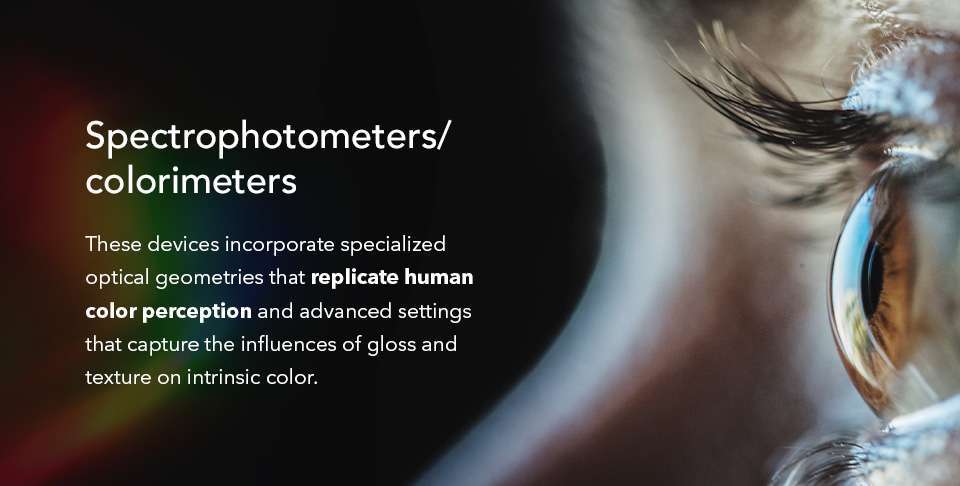
Spectrophotometers/colorimeters are the practical answer to those outdated visual color evaluations. These devices incorporate specialized optical geometries that replicate human color perception and advanced settings that capture the influences of gloss and texture on intrinsic color.

This equipment works by analyzing representative samples of a product or raw material and translating its color properties into numerical data. Users can then compare this data to established color scores and indices to scientifically determine whether goods fall within acceptable tolerances. Measurement is fast, and readouts are more reliable for supporting quality control and process improvements.

READ  Guide to Overcoming Color Challenges in Plastic Manufacturing

Develop Measurement Protocols

When implementing spectrophotometers/colorimeters into your workflows, it's essential to establish measurement protocols to uphold consistency throughout the manufacturing process. These include defining:

  • Regular measurement points: Quantify color data at various stages of manufacturing, from raw material intake to shipping from storage. Doing so helps you quickly identify where alterations occur and what processes or conditions may be causing them.
  • Shared color language with suppliers: Using the same color spaces across your supply ecosystem keeps everyone aligned on which scores, indices, and tolerances apply. A shared color language promotes harmony and supports accountability.
  • Standardization and calibration time frames: Determine when to standardize the spectrophotometer/colorimeter according to manufacturer recommendations and your workflows. It's also essential to get a yearly verification of calibration from the manufacturer to confirm accurate device performance.

Additionally, consider various industry and regulatory standards that may apply when establishing your protocols. For example:

  • ASTM E1164/ISO 7724 for defining proper reflectance measurement geometries and conditions
  • ASTM D2244 for the calculation of color differences (ΔE) and tolerance setting
  • ASTM E313 Standard for Yellowness and Whiteness Indices for monitoring recycled content
  • Industry-specific requirements, such as automotive OEM color standards, FDA food-contact packaging frameworks, and brand color standards
  • Quality system requirements for documenting traceability and consistency verification
  • ASTM D6290 for color measurement of plastic pellets

Choose the Right Spectrophotometer for the Task

Spectrophotometers/colorimeters come in various styles and configurations for unique plastics manufacturing applications, and the sample you're measuring is the determinant for choosing the right equipment. For example, opaque plastic pellets, plaques, films, and sheets require reflectance measurement — the device quantifies the intensity of the reflected light waves at specific visible wavelengths. Advanced spectrophotometers also go beyond intrinsic color measurement and provide objective data on how gloss and texture influence a sample's appearance.

INFO  Get More Information

Meet Agera L2: The World’s Best Spectrophotometer for Opaque Plastics

Explore the next generation of color measurement solutions for opaque plastics — the Agera L2 from HunterLab. We've developed this spectrophotometer/colorimeter to deliver unparalleled efficiency, accuracy, and value for color and appearance data.

Boost efficiency with a touch-screen display that's simple to navigate. This easy-to-use device provides results in under 3 seconds and stores up to 4 million records, promoting high throughput in busy production environments.

Built-in Easymatch Essentials L2 tablet-based software offers intuitive operation and fully self-contained color workstation functionality with no additional PC required. HDMI and USB ports support connections for a display, keyboard, or mouse if desired, though none are necessary for measurement, analysis, data storage, or reporting. Ethernet ports and USB connectivity make data sharing and export fast and easy for printing, analysis, or direct documentation within SPCs and LIMS.

HunterLab's Agera L2 also features a built-in, high-definition camera for image capture that empowers fast color quality decisions. An extra-large area of measurement provides insights across 4 to 16 times the surface measurement area of others. This intelligent design minimizes sample averaging needs and provides precise data that better reflects true appearance in nonuniform samples.

Our Agera L2 is engineered for precision measurements in critical industries. The onboard camera offers sample preview functionality, supporting correct, consistent presentation that helps reduce measurement discrepancies.

This spectrophotometer/colorimeter features reference-grade 0°/45° circumferential optical geometry and Certified Grade ‘A’ CIE D65 illumination for the truest representation of human color perception in daylight conditions.

We've also developed a specialized Dark Performance Mode for samples below 20% reflectance that enhances precision by up to 6x for the darkest plastics. Simultaneous 60° gloss measurement and controlled UV calibration further deliver high accuracy for complex plastics and assessment of OBA impacts. Additionally, automatic sample rotation rotates the sample by a specified number of degrees between measurements to help minimize orientation-related variability and improve overall measurement consistency for plastic pellets, plaques, and sheets.

Role-based user controls protect data integrity and support compliance with 21 CFR Part 11 for FDA-governed products. Plus, we've created the Agera L2 for reliable performance in rugged manufacturing settings. A sealed optical engine and enclosed housing withstand demanding facility conditions and ensure low maintenance requirements. We also stand behind this spectrophotometer/colorimeter with our signature lifetime technical support.

Trust HunterLab for Color Confidence

At HunterLab, we've been committed to providing the best color measurement solutions for more than 70 years. Our spectrophotometers/colorimeters help leading global brands overcome color quality and consistency challenges. Partnering with us means access to a team of color science experts who understand the unique issues with recycled content, optical brighteners, and surface characteristics that affect plastic appearance.

Connect with us online today to request a personalized demo, get a quote, or speak with our team for advice on the best color measurement solutions for your needs.