HunterLab
  • Products
    • Benchtop Spectrophotometers
    • Portable Spectrophotometers
    • Quality Control (QC) Software
    • In-Process / In-Line
  • Industries
    • Food
    • Beverages
    • Plastics
    • Chemicals
    • Bio-Pharma
    • Building Products
    • Paints & Coatings
    • Paper
    • Textiles
  • Learn
    • Measurement Methods
    • Glossary
    • Application Notes
    • Customer Stories
    • Product User Manuals
  • Company
    • About
    • History
    • Careers
  • Resources
    • Blog
    • Certifications
    • Customer Stories
    • Video Gallery
  • Contact
    • Support Website
    • Support, Services and Parts Queries
    • Product Queries
    • Our Location
  • Get Quote
  • Search
About
BLOG

Interested in a little light reading?

Our blog is continually updated with helpful educational information, advises, research and insights—all in the name of helping you level-up your colour and appearance needs. Grab a drink and enjoy our stories!

Explore Stories
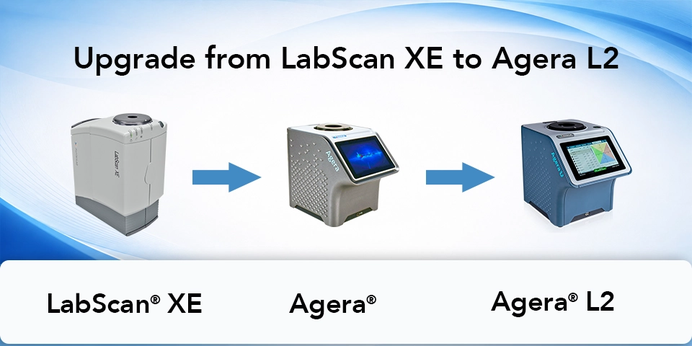
Upgrade to Agera L2 from LabScan XE

"LabScan XE to Agera L2 Upgrade: A Complete Transition Guide, Backed by HunterLab Support From Step One"

Read

Explore Our Products

View More

"Consistent Measuring of Coconut Water Colour and Haze"

Read

"Spectrophotometer Best Practices"

Read

LabScan XE to Agera L2 Upgrade: A Complete Transition Guide, Backed by HunterLab Support From Step One

Posted on Jun 17, 2026 by HunterLab

“My LabScan XE still seems to work. Why change anything?”

It's the right question to ask—and the honest answer is reassuring: you're not changing your color science at all. You're keeping the exact 0°/45° geometry, the CIELAB workflows, and the standards your lab has trusted for years. What changes is everything around the measurement: stability, repeatability, speed, and the confidence that one reading means the same thing in every lab, line, and location you run.

Here's the quiet truth about an instrument engineered in the late 1990s: every measurement still depends on a legacyxenon flash lamp and a web of legacy electronics, 12-volt and lamp power supplies, vintage circuit boards, and IC chips that haven't been manufactured in years. It works, until one morning it doesn't, usually the morning a release is waiting on your reading. The Agera L2 retires that dependency. Upgrading isn't only about better color data. It's about not being one aging component away from a stopped line, with no spare on the shelf and no quick fix in sight.

For most LabScan XE applications, the move to the Agera L2 is a natural evolution—not a change in color measurement methodology. Your existing workflows, color science principles, and visual evaluation philosophies remain fundamentally intact, while measurement stability, repeatability, and operational efficiency all improve. The results from Agera L2 are reference-grade: inter-instrument agreement of ΔE2000 < 0.10 and repeatability of ΔE* < 0.03. And HunterLab is beside you at every step, so the standards you built carry forward.

This guide shows you exactly what stays the same, what gets better, and how the transition protects the work you've already done.

Key Takeaways

  • Nothing you rely on changes. Same 0°/45° geometry and color science, so your standards, tolerances, and QC methods carry straight over.
  • Your color data gets even more trustworthy. Certified Grade “A” CIE D65 illumination, a 6× precision gain on dark samples below 20% reflectance, and the industry's largest area of view (4–16× more sample) mean fewer disputes and faster approvals.
  • Agera L2 is reference-grade, and here's the proof: inter-instrument agreement of ΔE2000 < 0.10, repeatability of ΔE* < 0.03, and a read time under 3 seconds.
  • LabScan XE To Agera L2 transition is fully guided by HunterLab experts. A focused correlation study validates fluorescent, brightened, and high-whiteness materials—and HunterLab runs it with you.
  • Built for what you measure: plastics and recycling, packaging, retroreflective and safety materials, textiles, coatings, pharmaceuticals, petrochemicals, paper, and anything at 20% reflectance or less.

Watch: Agera L2 Overview

Get a three-minute look at the Agera L2 before you read on—how it measures color the way the eye sees it, and what makes it reference-grade.

Watch the overview video ->

Posted in Benchtop

Consistent Measuring of Coconut Water Colour and Haze

Posted on Sep 02, 2022 by HunterLab

Coconut water is a multi-billion dollar industry that is expected to expand globally to US$8.3 billion by 2022.1 Consumers have been drawn to coconut water’s sweet, refreshing taste and unique chemical composition, similar to blood plasma, which is rich in carbohydrates and important nutrients such as magnesium, calcium, and phosphorus.1 These nutrients also make coconut water a naturally rehydrating sports drink which has increased market appeal. Fresh coconut water from young, green coconuts is particularly valued for a delicate taste and increased antioxidant benefits.

When first poured from the coconut shell, coconut water is a clear, colorless liquid that can be combined with the interior pulp for additional texture and variety. Colour changes can occur in harvesting, cracking, sterilization, and storage processes so the final beverage can fluctuate from translucent white to pale yellow and even bright pink.1 Products can also include varying levels of pulpin the liquid depending on geographical region, harvesting practices, pasteurization, and market targeting, such as coconut beverages which are sold with pulp.

Sold coconut water’s final product is a combination of the colour and pulp concentration, or turbidity of the water. With so many different variables, it can be challenging to maintain a consistent product. However, Hunter Spectrophotometric technology, with innovations in colour and haze measurements, can offer innovative solutions for measuring both colour and haze in a single reading of coconut water for consistent, reliable production. The Haze measurement can be substituted for a turbidity measurement done on a separate instrument.

DIFFICULTIES OF CONSISTENT COLOUR AND HAZE IN COCONUT WATER

When your customer picks up a cooled bottle of coconut water from the store refrigerator, what theysee through the plastic is a combination of colour, usually light white to pale yellow, and pulp concentration. Strolling down the beverage aisle, there are many different brands of coconut water, each with a reliable, consistent appearance to build brand trust with their customer. But from shell to bottle to store, a consistent appearance isn’t so simple, as multiple variables, including chemical properties, harvesting and storage methods, and product differences, influence the final product.

These difficulties begin with the coconut. Since coconut water has a high pH, varying from 5 – 5.4, it is subject to rapid deterioration and fermentation once exposed to oxygen.1 Young coconut water, which is harvested one month earlier than mature coconuts, has a lower pH but higher phenolic content, as well as greater polyphenol oxidase (PPO) and peroxidase (POD) enzyme activity. The increased phenol content raises antioxidant levels and health benefits,, but higher PPO and POD also raises the water’s susceptibility to oxidation1 Within minutes of first cracking, yellow, amber, brown, or even pink discoloration can bloom across the harvested water’s surface.

To keep the water from spoiling early, whole nuts are gently harvested and stored for up to six days till extraction inside the plant. But new challenges arise with processing. During cracking and harvesting, coconut water can become cloudy from the accidental shell and coconut meat debris, or by adding pulp for a pulped coconut beverage. Once harvested, coconut water must quickly be sterilized and bottled which can also cause changes in the coloring.  To prevent this, conventional thermal techniques, as well as cooling, freezing, or adding stabilizing juices such as pineapple, are quickly used to prevent further discoloration.2 In spite of these prevention methods, if the storage space is not properly temperature controlled, then discoloration can occur in storage and transportation to the store.

With all these different variables, the challenges of delivering a consistent coconut beverage can seem high. Consistency and reliability however, are the cornerstone of branding in a saturated market. It is also distinctly important to have a consistent colour and haze for naturally harvested products to develop consumer trust.

Posted in Benchtop

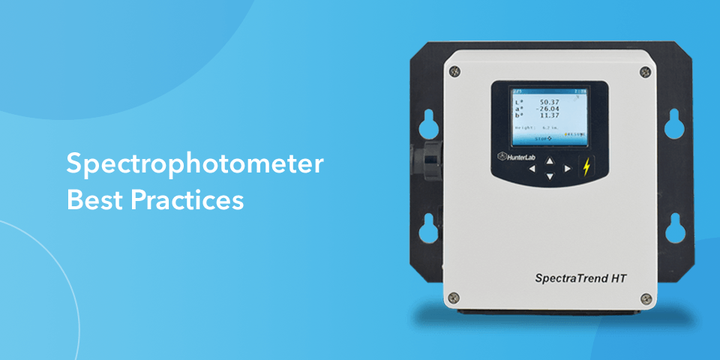
Spectrophotometer Best Practices

Posted on Sep 01, 2022 by HunterLab

Spectrophotometers are invaluable to many industries, ranging from the food to plastics industries and beyond, delivering the colour consistency necessary to streamline supply chain efficiencies and maximize product quality. The key to ensuring reliable performance and colour measurement quality is knowing how to properly maintain a spectrophotometer.

What Is the Function of a Spectrophotometer?

A spectrophotometer scientifically measures the colour of materials using a light source, wavelength-selective optics, sensors, and software to convert emitted energy to an industry-standard colour scale. This measurement enables companies to verify the quality and consistency of their products, ingredients, and raw materials. The device mimics how the human eye sees colour but eliminates error-prone manual visual observations for higher accuracy.

Best Practices for Using and Taking Care of Your Spectrophotometer

Spectrophotometers must undergo the proper routine maintenance to deliver the most precise and accurate measurements. With the right standardization and care, you can ensure your colour spectrophotometer performs at its best.

1. Perform Routine Maintenance

A well-maintained device provides the most accurate and reliable readings. Maintenance begins with a thorough cleaning. No matter how well-calibrated your device is, it won’t deliver accurate or consistent readings if it isn’t clean. That’s why it’s vital to ensure your spectrophotometer is free of dirt, dust, grime, and other contaminants that can obscure measurement results.

When cleaning your equipment, it’s crucial to follow the best practices outlined in your user manual to avoid damaging the device and invalidating your warranty. Avoid using any harsh or abrasive tools or substances when cleaning your spectrophotometer.

Cleaning frequency varies based on the components. The exterior of the sensor and mounting generally require weekly cleaning. If your work involves messy samples that contact the sensor, you may also have to clean between measurements.

You should also consider your environment when determining cleaning frequency. For example, a unit stored in a dusty, poorly ventilated closet will require more routine cleanings than one contained in an air-conditioned office.

Other routine maintenance checks include:

  • Inspecting and cleaning the power cord
  • Verifying the optics are clean and in good condition
  • Testing general structures like the device touch screen or buttons

Beyond these general checks, each model operates differently. Check the owner's manual for additional maintenance procedures specific to the device.

Posted in Benchtop
Prev
1
Next

Most Related Posts

  • LabScan XE to Agera L2 Upgrade: A Complete Transition Guide, Backed by HunterLab Support From Step One
  • Consistent Measuring of Coconut Water Colour and Haze
  • Spectrophotometer Best Practices
View More

Follow Us

  • LinkedInFollow us on LinkedIn
  • YouTubeFollow us on YouTube
  • facebookFollow us on Facebook
  • XFollow us on X (formerly Twitter)
  • instagramFollow us on Instagram

HunterLab

703.471.6870

Corporate Headquarters
11491 Sunset Hills Road
Reston, Virginia 20190

  • Products
    • Benchtop Spectrophotometers
    • Portable Spectrophotometers
    • Quality Control (QC) Software
    • In-Process / In-Line
  • Industries
    • Food
    • Beverages
    • Plastics
    • Chemicals
    • Bio-Pharma
    • Building Products
    • Paints & Coatings
    • Paper
    • Textiles
  • Learn
    • Measurement Methods
    • Glossary
    • Application Notes
    • Customer Stories
    • Product User Manuals
  • Company
    • About
    • History
    • Careers
  • Resources
    • Blog
    • Certifications
    • Customer Stories
    • Video Gallery
  • Contact
    • Support Website
    • Support, Services and Parts Queries
    • Product Queries
    • Our Location

Get in touch

  • Instagram
  • Facebook
  • LinkedIn
  • Twitter
  • Certifications
  • Terms and Conditions
  • Privacy Policy
  • Sitemap
  • Code of Conduct