HunterLab
  • Products
    • Benchtop Spectrophotometers
    • Portable Spectrophotometers
    • Quality Control (QC) Software
    • In-Process / In-Line
  • Industries
    • Food
    • Beverages
    • Plastics
    • Chemicals
    • Bio-Pharma
    • Building Products
    • Paints & Coatings
    • Paper
    • Textiles
  • Learn
    • Measurement Methods
    • Glossary
    • Application Notes
    • Customer Stories
    • Product User Manuals
  • Company
    • About
    • History
    • Careers
  • Resources
    • Blog
    • Certifications
    • Customer Stories
    • Video Gallery
  • Contact
    • Support Website
    • Support, Services and Parts Queries
    • Product Queries
    • Our Location
  • Get Quote
  • Search
About
BLOG

Interested in a little light reading?

Our blog is continually updated with helpful educational information, advises, research and insights—all in the name of helping you level-up your colour and appearance needs. Grab a drink and enjoy our stories!

Explore Stories

"Is it possible to create ASTM traceable haze standards above 30%?"

Read

Explore Our Products

View More

"Measuring the Colour of Clear Liquids"

Read

"The details of how HunterLab sphere instruments conform to ASTM D1003 Section 8: Procedure B Spectrophotometer for transmission haze measurement"

Read

"Do you know what Molten Colour is?"

Read

"Do you have a source for liquid Saybolt and ASTM D1500 Colour Standards?"

Read

"How do I measure “clear and colorless” Surfactants?"

Read

"How do you validate a APHA/Pt-Co/Hazen 500 liquid colour standard?"

Read

Is it possible to create ASTM traceable haze standards above 30%?

Posted on Nov 29, 2023 by HunterLab

Beyond ASTM D1003 Haze Standards Exploring Transmission Haze Metrics and Practical Considerations for Translucent Materials

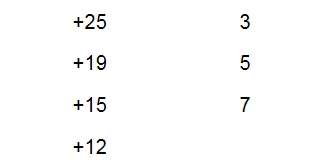
The current, available ASTM D1003 Haze Standards have nominal Haze% values of 1, 5, 10, 20 and 30 with air (transparent solids) or the transmission cell filled with DI water being 0 (transparent liquids). Here are some thoughts on further options.

Thirty (30) is not a magic number but above that value, it is considered that your samples are moving from a transparent material to a translucent material.

As a metric, ASTM D1003 Transmission Haze was designed to measure scattering in near clear, transparent materials. At a level above 30, you are moving out of the intended range of the metric.

If you have an instrument that is measuring an ASTM D1003 Haze 30 standard in close agreement with assigned values, you can have a high degree of confidence that it is reading haze well above that point. However, please note that when you get above 50, you are well beyond the intended use of the metric.

At this point, we generally recommend that customers use Y Transmission (C/2, D65/10; Total Transmission mode) to separate lot differences in translucent materials.  Y Transmission measures the total amount of light that comes through the translucent material with air (transparent solids) or the transmission cell filled with DI water being 100 (transparent liquids).

If you said that you need a PQ performance Qualification standard at a Haze level > 30 to verify instrument performance, you could make your own by purchasing a chemically abraded glass sample (at least 50 mm x 50 mm in size) and benchmarking the Haze value yourself.

Glass is very stable and if kept clean should serve this purpose well.

This abraded glass sample could be measured on your instrument over time in comparison to your baseline values to verify that the instrument is consistent at this higher level of haze.

Posted in Chemical

Measuring the Colour of Clear Liquids

Posted on Nov 29, 2023 by HunterLab

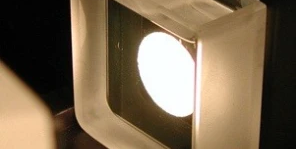
Liquid Fragrance Sample

Maintaining Colour Consistency in Clear Liquids

HunterLab diffuse sphere instruments are often used to measure liquid samples, especially clear liquids. The liquid fragrance shown above is one such example of a clear liquid. The fragrances is so clear that is resembles water.

Fragrances such as this are often added to cleaning supplies, air fresheners, or other consumer products. One of the problems that this type of sample can experience is that the chemistry of the liquid fragrance solution can deteriorate and the solution will start to visually yellow. This is often a concern for manufactures because if the liquid fragrance yellows it cannot be added to the end product.

HunterLab sphere instruments can measure the transmitted colour of the liquid and report the yellowness index. The liquid fragrance should be measured in a 20mm path length cell. Since the sample is very clear, near water in colour, this slightly larger path length allows for the light to pass through more of the sample. This measurement method ensures that smaller differences can be measured between samples.

With the proper instrument and the appropriate accessories from HunterLab, very clear liquid samples can be accurately and repeatedly measured for colour consistency.

Posted in Chemical

The details of how HunterLab sphere instruments conform to ASTM D1003 Section 8: Procedure B Spectrophotometer for transmission haze measurement

Posted on Apr 20, 2023 by HunterLab

HunterLab sphere instruments with CIE d/8 geometries conform to the requirements of ASTM D1003 Section 8: Procedure B Spectrophotometer. The measurement of transmission haze using Procedure B instruments will be in close agreement with ASTM D1003 Procedure A Haze meter.

Meeting ASTM D1003 Section 8 Procedure B Requirements

Here is a more detailed description of how the HunterLab UltraScan PRO and UltraScan VIS meet the requirements of Section 8.

  1. Procedure B (Spectrophotometer)

8.1 Apparatus:

8.1.1 The instruments used for measurement shall meet the geometric and spectral requirement of this section.

HunterLab UltraScan VIS and UltraScan PRO instruments meet ASTM D1003 Section 8 Procedure B Spectrophotometer requirements.

8.1.2 The instrument shall be capable of computing from the spectral data the 1931 CIE tristimulus values and related colour coordinates for CIE standard Illuminant C or alternatively Illuminant A.

HunterLab offers A/2 and C/2 options for calculating Haze%, Y Total and Y Diffuse luminous transmission in EasyMatch QC software.

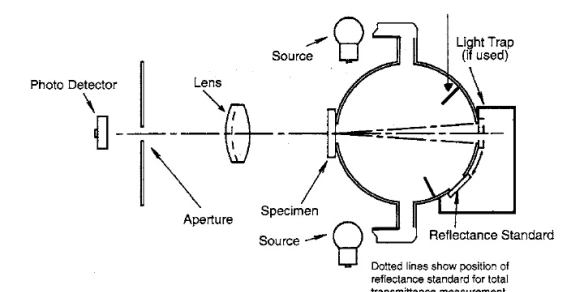
8.1.3 The instrument shall utilize a hemispherical optical measuring system, with an integrating sphere, in which the specimen can be placed flush against the sphere port. The surfaces of the interior of the integrating sphere, baffles, and reflectance standards shall be matte, of substantially equal reflectance and highly reflecting throughout the visible wavelengths.

HunterLab UltraScan VIS and UltraScan PRO sensors and internal components are coated with Spectralon having a 99%+ reflectance. Transparent specimens for haze measurement are placed at the TTRAN port, flush against the sphere.

The UltraScan VIS and Pro come with white, Japanese commercial opal reflectance standard of 99%+ reflectance.

8.1.4 Two geometries can be used: unidirectional illumination with diffuse viewing and diffuse illumination with unidirectional viewing. Using diffuse illumination with unidirectional viewing, the following apply:

HunterLab UltraScan VIS and UltraScan PRO sensors have a diffuse illumination with unidirectional viewing (8°) geometry. They are referred to as CIE-conforming diffuse d/8° sphere instruments.

8.1.4.1 Use an integrating sphere to illuminate the specimen diffusely; the sphere may be of any diameter as long as the total port areas do not exceed 4.0 % of the internal reflecting area of the sphere. The specimen and light trap ports of the sphere shall be centered on the same great circle of the sphere, and there shall be at least 2.97 rad (170°) of arc between their centers.

The light trap port shall subtend an angle of 0.14 rad (8°) at the center of the specimen port along the wowing beam. With the light trap in position, without specimen the axis of the viewing beam shall pass through the centers of the specimen and light trap ports.


Posted in Chemical

Do you know what Molten Colour is?

Posted on Apr 20, 2023 by HunterLab

FAQ:”A client is asking me to measure something they call “Molten Colour’. Do you have any information on this? Do Hunterlab instrument have a function for this colour?”

“Molten Colour” is not a defined colour scale but refers to melting chemical crystalline or powder material such as Maleic or Phthalic Anhydride, into a liquid at an elevated temperature in the 140 – 250 C range.

Industrial Standard References for Molten Colour Applications

APHA/Pt-Co Colour measurement is a colour quality attribute of BPA Bisphenol A, Cresylic Acids, Maleic and Phthalic Anhydride; Cresylic Acids and aromatic hydrocarbons prepared by heating to a liquid form.

  • ASTM D1686 Test Method for Colour of Solid Aromatic Hydrocarbons and Related Materials in the Molten State (Platinum-Cobalt Scale)
  • ASTM D3366 Standard Test Method for Colour of Maleic Anhydride and Phthalic Anhydride in the Molten State and After Heating (Platinum-Cobalt Scale)
  • ASTM D3627 Standard Test Method for Colour of Cresylic Acids (“C” Series Standards)
  • ASTM D4789 Standard Test Method for Solution Colour of Bisphenol A (4,4´-Isopropylidenediphenol)

ASTM – American Society of Testing and Materials, West Conshohocken, PA USA www.astm.org

Posted in Chemical

Do you have a source for liquid Saybolt and ASTM D1500 Colour Standards?

Posted on Apr 20, 2023 by HunterLab

Spectrum Quality Standards

These liquid visual colour standards can be used as an independent test to verify instrumental Saybolt and ASTM D1500 Colour measurement performance over time for these two visual colour scales used to evaluate oil, oil additive and petrochemical colour quality.

Spectrum Quality Standards Inc.

Houston, TX 77084 USA

+281-578-7575

www.spectrumstandards.com

List of available liquid Saybolt and ASTM D1500 Colour standards for performance verification.

Spectrum Quality Standards is a small company that primarily makes GC and Physical Properties standards for the petroleum industry. Spectrum Quality also sells liquid Saybolt and ASTM D1500 colour standards as defined in Appendix X1 of ASTM D6045.

You can buy a set if you want to check the entire range in each scale, or if your product purchase specification must be less than a maximum Saybolt or ASTM D1500 value, you could purchase an individual liquid standard at that level to monitor and document measurement performance over time.

Posted in Chemical

How do I measure “clear and colorless” Surfactants?

Posted on Apr 20, 2023 by HunterLab

FAQ: “We are in touch with a pharmaceutical company which is looking for a spectrophotometer to measure the colour and appearance of cationic surfactants. Can you provide any information on this topic?”

Surfactants reduce the surface tension of a liquid as in the use of a dish detergent; the interfacial tensions between two liquids such as in the case of an oil spill in water, or of laundry detergent removing soil from clothes in water.

Surfactants have two parts within a single molecular structure  – a hydrophilic (or water-loving) head and a hydrophobic (water-repellent or oil-loving) tail. The hydrophobic part is typically a long hydrocarbon chain of different types. The polar hydrophilic head group can be non-ionic (no-charge), anionic (positive charge), cationic (negative charge) and zwitterionic (two opposite charges).

In terms of colour and appearance quality, transparent surfactants are often visually described in product specification sheets as “clear and colorless”, almost “water white”, without apparent visual haze. “Colorless” in measurement terms, means being a close as possible to distilled water with only trace yellowness. Being “clear” means being as close to distilled water as possible in not scattering light.

How to Measure Surfactants on HunterLab Sphere Instruments

  1. Any of HunterLab’s diffuse d/8° sphere instruments such as UltraScan VIS or UltraScan PRO are appropriate for this application. Additional required accessories are a  50 mm path length transmittance cell (13-8573-20 or 20 mm path length cell ( 04-4592-00) and a Transmittance Cell Holder (C02-1005-481).
  2. Configure the Colour Data View in EasyMatch QC software to display:
    1. CIE L*, a*, b* D65/10° or C/2° as a full colour descriptor. While these values are good to report, APHA and Haze% will be the two metrics best able to distinguish slight lot differences in very clear and colorless surfactants.
    2. APHA-50 mm [C/2°] or Yellowness Index YI E313 [C/2°] to quantify trace yellowness.Typical purchase specifications indicate a maximum APHA value of 5 to 30, with distilled water being 0.
    3. Haze% to measure trace scattering to indicate how “clear” the sample is. DI water will have 0% haze. A visual difference in haze can typically be seen around 4%.
    4. As an optional metric, Y Total Transmittance can be configured to quantify the total amount of light passing through the sample with DI water as a reference for 100% transmittance.
  3. Standardize any HunterLab sphere instrument in TTRAN (Total Transmittance) LAV (Large Area of View) mode using:
    1. The Light Blocker to set 0% transmittance.
    2. The 50-mm path length transmittance cell filled with DI water and the white calibrated tile at the reflectance port to set 100% transmittance.
  4. As a recommended PQ (Performance Qualification) step, leave the cell with DI water in place at the TTRAN port. Then measure DI water as a product standard. If the instrument is set up correctly, distilled water in the 50 mm cell should measure closely to CIE L* = 100.0, a* = 0.0, b* = 0.0; APHA = 0.0; YI E313 [C/2] = 0.0; Haze% = 0.0 and Y Total Transmittance = 100.0.
  5. As an optional Application Diagnostic step, a liquid APHA Colour standard can be purchased with nominal values similar to the product specification (APHA 5, 10, 20 or 30), then measured for APHA 50-mm and Haze% on the first day to establish baseline values. The measured baseline APHA value should closely match the assigned APHA value for the standard. The baseline Haze% should be low, typically < 1%. Measurements of the APHA liquid colour standard should match the baseline values closely over time to affirm that your instrument is consistent in measuring APHA Colour and Haze%.
  6. Proceed to measure batch lots of surfactants and report APHA and Haze% to document process differences by lot and conformance to product colour and appearance specifications.

Posted in Chemical

How do you validate a APHA/Pt-Co/Hazen 500 liquid colour standard?

Posted on Apr 20, 2023 by HunterLab

As described in Section 6 of ASTM D1209, there are 2 criteria to validate a APHA/Pt-Co 500 standard:

  • The APHA/Pt-Co 500 Colour Standard must have a defined chemical composition and be prepared in accordance with section 6 of ASTM D1209.
  • After preparation, the APHA/Pt-Co 500 standard must meet a absorbance criteria at 4 points in the blue region of the visible spectrum per Table 1 of ASTM D1209.
  1. Platinum-Cobalt Reference Standards

6.1 Platinum-Cobalt Stock Solution— Dissolve 1.245 g of potassium chloroplatinate (K2PtCl6) and 1.00 g of cobalt chloride (CoCl2·6H2O) in water. Carefully add 100 mL of hydrochloric acid (HCl, sp gr 1.19) and dilute to 1 L with water. The absorbance of the 500 platinum-cobalt stock solution in a cell having a 10 mm light path, with reagent water in a matched cell as the reference solution, must fall within the limits given in Table 1.

Posted in Chemical
Prev
1
2
3
Next

Most Related Posts

  • Is it possible to create ASTM traceable haze standards above 30%?
  • Measuring the Colour of Clear Liquids
  • The details of how HunterLab sphere instruments conform to ASTM D1003 Section 8: Procedure B Spectrophotometer for transmission haze measurement
  • Do you know what Molten Colour is?
  • Do you have a source for liquid Saybolt and ASTM D1500 Colour Standards?
  • How do I measure “clear and colorless” Surfactants?
  • How do you validate a APHA/Pt-Co/Hazen 500 liquid colour standard?
View More

Follow Us

  • LinkedInFollow us on LinkedIn
  • YouTubeFollow us on YouTube
  • facebookFollow us on Facebook
  • XFollow us on X (formerly Twitter)
  • instagramFollow us on Instagram

HunterLab

703.471.6870

Corporate Headquarters
11491 Sunset Hills Road
Reston, Virginia 20190

  • Products
    • Benchtop Spectrophotometers
    • Portable Spectrophotometers
    • Quality Control (QC) Software
    • In-Process / In-Line
  • Industries
    • Food
    • Beverages
    • Plastics
    • Chemicals
    • Bio-Pharma
    • Building Products
    • Paints & Coatings
    • Paper
    • Textiles
  • Learn
    • Measurement Methods
    • Glossary
    • Application Notes
    • Customer Stories
    • Product User Manuals
  • Company
    • About
    • History
    • Careers
  • Resources
    • Blog
    • Certifications
    • Customer Stories
    • Video Gallery
  • Contact
    • Support Website
    • Support, Services and Parts Queries
    • Product Queries
    • Our Location

Get in touch

  • Instagram
  • Facebook
  • LinkedIn
  • Twitter
  • Certifications
  • Terms and Conditions
  • Privacy Policy
  • Sitemap
  • Code of Conduct