
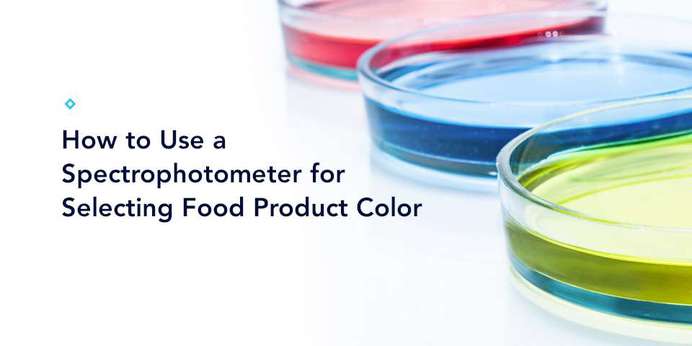
The colour of food significantly impacts consumer appeal and quality perception, cementing the importance of selecting food coloring and measuring it regularly to ensure consistency. Spectrophotometers simplify scientific, objective food coloring measurements to help food manufacturers reach quality goals, reduce waste, and influence customers' buying decisions. The following tips will guide you in identifying and using the best solution for determining food coloring data in your products.

Choose Equipment Based on Food's Physical Properties

Your sample's physical properties are the starting point for choosing the right spectrophotometer to measure food coloring. For example, you can quantify the colour of transparent liquids like sports drinks using a device that captures transmittance measurements. Nonuniform, opaque, and highly textured foods will require a solution that accurately measures colour by reflectance. Consider options capable of transmittance and reflectance measurement or simultaneous colour and haze data capture for added versatility.

Similarly, physical characteristics like the food's fat content also impact colour since dyes and pigments are either oil-soluble or water-soluble. A spectrophotometer provides real-time insights to ensure the colorant you choose meets quality and appeal expectations.
Read  Spectrophotometer vs. Colorimeter: What’s the Difference?

Consider Consumer Preferences and Safety

Today's consumers are more health-conscious than ever, and laws governing food colorants and dyes continue changing. In turn, many manufacturers are shifting to more natural food dyes.

Quantifying natural colorants is critical to meeting safety regulations set by the Food and Drug Administration (FDA) under Title 21 of the Code of Federal Regulations. For example, beta-carotene — a popular natural food colorant for fats, fruit juices, and dairy products — may be used up to the limits specified under current good manufacturing practice.

The spectrophotometric solution you choose should support consumer preferences and compliance by measuring for comparison against the colour scales and indices used in your specific industry. For instance, the Gardner Colour Scale is the preferred choice for measuring yellowness in transparent liquids, such as edible oils.

Measure the Effects of Processing

The processing steps you use in production can also substantially impact food colour through chemical changes in dyes and pigments. Excess exposure to high temperatures frequently affects colour stability, especially in dyes like FD&C Red #40 or natural colorants like beet juice. The longer exposure continues, the more pronounced the effects become.

The right spectrophotometric solutions will help you capture and quantify food coloring data at each processing stage. By doing so, you can identify where changes occur so you can adjust your processes to prevent waste and achieve more colorant consistency.

INFO  Get More Information

Find Your Ideal Food Coloring Spectrophotometer With HunterLab

HunterLab is the world's most trusted manufacturer of spectrophotometers for food colour measurement. Our innovative solutions have empowered colour quality across demanding industries for over 70 years.

Talk to our colour science experts online for equipment quotes or buying advice for your needs.