
Understanding colour codings in business is important for safety, disaster preparedness, and adherence to safety agency guidelines. The Occupational Safety and Health Administration (OSHA) and the American National Standards Institute (ANSI) have standards for safety colour codings for industrial environments. This guide to industrial colour-coding explains what each colour means and where to use it.

Purpose and Benefits of Industrial Business Colour Codings

Colour coding in industrial settings is used as an essential safety measure. Different risks, dangers and safety hazards are assigned a certain colour. Colours are better than verbiage because colours are universal and easier to identify from a distance. Workers immediately recognize colours and their meaning concerning different safety hazards. You can implement these colours anywhere you think is necessary for your facility.

benefits-of-safety.png

The benefits of safety colour codings include:

  • Increase your employees’ productivity and safety by reducing the likelihood of accidents and errors.
  • Standardize visual communication to eliminate speculation.
  • Protect your assets from environmental factors.
  • Simplify tasks.
  • Enhance your facility’s appearance.
Read  Colour Standards for the Paper Industry

Colour Meanings in Industrial Settings

Here is a list of the colours used in industrial settings and what they represent:

  • Red: Identifies fire protection equipment and hazardous areas.
  • Orange: Identifies dangerous machine and equipment parts.
  • Yellow: Identifies physical hazards and materials that are potentially hazardous to life and property.
  • Green: Identifies first aid equipment, materials, and areas that are nonhazardous to life and property.
  • Blue: Identifies safety information on bulletin boards and signs.
  • Purple: Identifies radiation hazards.
  • Black and white: Identifies trafficked areas.

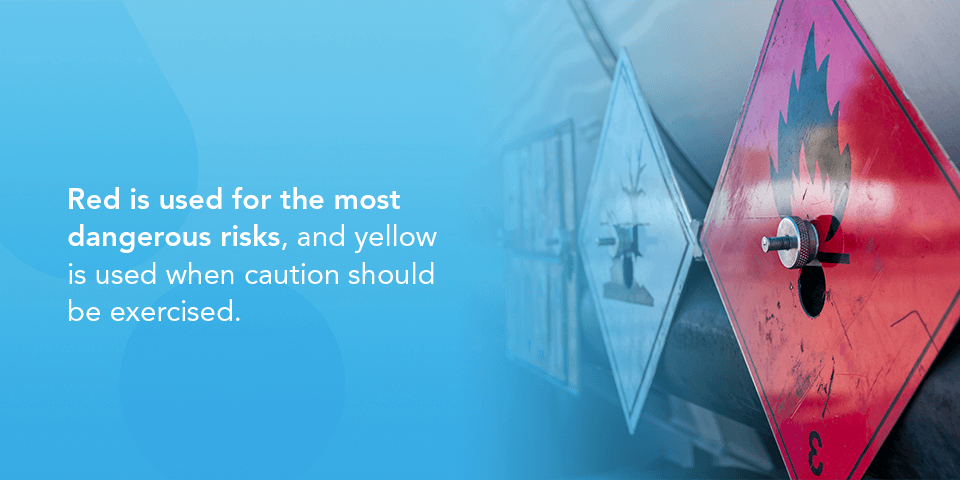
OSHA has two categories of safety colour codings — physical hazards and accident prevention. Physical hazard colours provide immediate identification of protection equipment, physical risks and power buttons and switches. Accident prevention colours are used for safety signs and tags to indicate dangerous substances and incidents. Red is used for the most dangerous risks, and yellow is used when caution should be exercised.

INFO  Get More Information

Water lines, wastewater lines, chemical lines, and other lines all have colour standards to show what the pipes are used for. Pipes also have flow arrows on the sections that pass through a wall.

Contact-HunterLab-Today-1.png

Contact HunterLab Today

HunterLab has been the thought leader in colour measurement technology for more than 65 years. We are ready to work with your business for your colour consistency needs. Contact HunterLab online for more information about industrial business colour codings. Read our blog for posts about colour meanings and more.