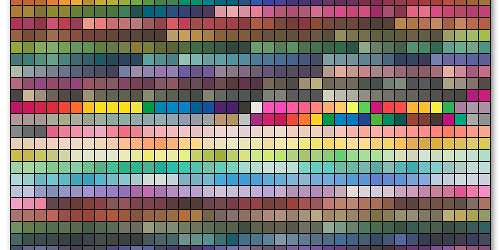
Ink colour options and combinations are endless, so special attention must be paid to mixing and matching inks. Ink colour density directly affects colour outcome, and careful measurement of both density and colour are necessary to achieve desired results. Image Source: Flickr CC user ben [deleted]

My years in the printing industry taught me one thing—colour matters. But when you’re working with ink, colour matching is a challenge, especially if you have high standards. Ink colour density plays an important role for in-line colour printing and has a direct effect on colour uniformity and final outcome. Colour density measurement can be achieved in several ways, of course, but spectrophotometers are the most versatile option for advanced control and quality.

Many major print media and label corporations are unaware of their options—or the capabilities of spectrophotometric instrumentation. As product supplies and industry needs continue to change, new innovations in spectral technology are keeping pace. And since challenges in ink colour density measurement can affect many areas of product development, instrumental analysis is a key method of staying competitive in a growing market.

Read  From Clear to Pure: Chemical and Colour Analysis in the Petrochemical Industry

Looking Beyond Density Measurement

Although density measurement does provide quantitative data on colour, it’s only a small piece of what is actually perceived by the human eye. Because many factors affect colour perception, density measurement alone is subject to visual discrimination.  Densitometers also use absorption measurements, which only provide limited data on colour changes and uniformity1.  Although this technique can be effective when determining ink film thickness or when contrast monitoring is needed for performance feedback, it is limited in providing colour data for quality control assessment.

Spectrophotometers offer a more comprehensive evaluation of colour that correlates directly with human visual perception.  Rather than using only one viewing angle and light source, spectral technology integrates various geometric principles and optical pathways to achieve the best representation of colour data—regardless of the medium being used. Since spectrophotometers account for ink properties as well as application processes and types of paper, they are able to monitor reflectance values and saturation levels, providing the additional information needed to achieve highly accurate results. Given the increasing number of specialized materials used by the printing industry, this capability is especially important. From high-gloss or matte finish papers and inks to UV formulations, spectrophotometers offer much-needed versatility.

2198273083_deb59ab2c8_z.jpg

Many printing applications that are used outdoors require inks that can withstand prolonged exposure to the elements. Spectrophotometers effectively measure UV resistance, assisting in the development of advanced UV ink products. Image Source: Flickr CC user Justin Taylor

INFO  Get More Information

Utilizing Spectrophotometric Instrumentation

The number one priority in the printing industry is keeping the customer happy. This requires an agreement on colour standards between ink supplies and printing companies so that consumer expectations can be met. In an interview with Ink World Magazine, Michael Impastato, vice president of market development at Flint Ink Corporation states that “printers are looking for colours that match their customers’ expectation. This involves more than colour matching. First, the printer and the ink maker must establish a good colour standards program. The colour standards have to be agreed upon by all parties: the customer, printer and ink maker. These ‘approved’ standards become the bible”2. And colour matching that spans all levels of manufacturing requires instrumental analysis. Spectrophotometers combine the highest level of colour technology with integrated software, allowing you to analyze and store data for consistency and repeatability. Spectral instrumentation can then be used to develop a colour tolerance standard, which is the best way to effectively communicate colour standards between all parties.

Quantifiable colour data not only assures colour agreement—it can be used to monitor processing changes throughout production. Spectrophotometers utilize reflectance and transmittance measurements to define colour space values, which can be translated using systems such as CIE L*a*b*or Hunter Lab. And with advanced technology, assessment of both liquid and solid ink samples is attainable and can provide instant data on colour variations. By comparing a sample to a colour standard, operators can instantly identify whether it falls within the acceptable colour range, ensuring batch-to-batch and lot-to-lot consistency.

8078224604_139f58cbd2_z.jpg

Colour clarity and design elements must be consistent from batch to batch to ensure functionality and customer satisfaction. Image Source: Flickr CC user Rusty Clark – On the Air M-F 8am-noon

Options in Colour Assessment and Instrumentation

Advancements in colour technology have led to innovative solutions in ink colour analysis and print media assessment. Instrument options such as hand-held or bench-top models provide the portability and durability needed for industrial use, while in-line process monitoring systems provide the consistent data needed for high-speed production. And thanks to instant data, each colour measurement tool is designed to allow real-time adjustments, saving both time and materials.

HunterLab is a leader in spectrophotometry and innovative design. We offer solutions for every aspect of the printing industry, with instrumentation options available to meet any budget or need. Our colour measurement tools are top of the line and simple to use. We work together with our clients to help them make the most of their colour measurement instrumentation and address any challenges they may have. Contact us today, and let us know how we can help you increase customer satisfaction and the quality of your products.