
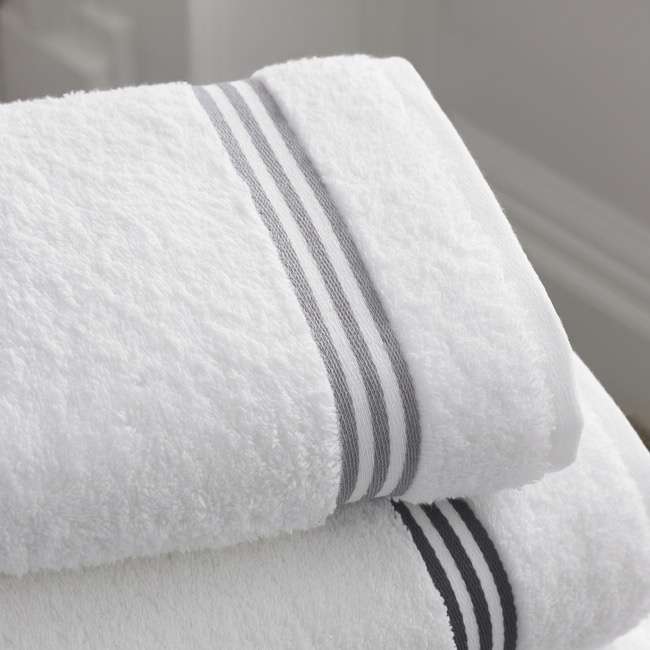
White textiles are part and parcel of the hotel experience, reassuring guests of cleanliness, freshness, and comfort. Image Source: Pexels user Karolina Grabowska

White holds a special place in the textile industry, where it is considered the gold standard for linens produced for hospitality and healthcare environments. The tradition of white hospital and hotel bedding, restaurant tablecloths, and lab coats is rooted in much the same colour psychology that makes wedding gowns, communion dresses, and unicorns white: whiteness is a visual symbol of purity, cleanliness, and freshness.

As Andre Picard writes in a fascinating article on the history of the white lab coat, “White is the colour of hope and the lab coat the symbol of the healer.”1 Meanwhile, hotel patrons know there’s nothing quite like crisp white sheets to reassure you of an establishment’s commitment to cleanliness and gives you that special hotel feeling. The North Ocean Hotel notes:

It’s psychologically important for the guest to see clearly how clean a room and bed is. That effect cannot be underestimated as it influences everything else in the customer experience from that moment on.2

But the use of white linens in the hospitality and healthcare sectors is as much a matter of practicality as emotion. Sticking to white allows all textiles to be washed together saving valuable sorting time. Additionally, white textiles tolerate many specialized cleaning solutions better than colored fabrics, allowing for hygienic sanitation and visual refreshing.

All whites, however are not created equal; even slight variations in colour can have a profound impact on the perceived cleanliness of a sheet, towel, or lab coat. As such, textile manufacturers must take great care to monitor the colour of white textiles to ensure a satisfactory aesthetic appearance.

The whiteness of lab coats is as important psychologically as it is practically. Image Source: Pexels user Wesley Wilson
Read  Spectrophotometry in Fabric Production: Achieving Colour Conformity in Blends of Natural and Synthetic Fabrics

Measuring the Colour of White Textiles

The whiteness of a fabric is the product of three components:

  • Base White: Base white is the whiteness of the raw fabric. This white has a yellow tint due to the fact that cotton fabric absorbs some blue light, preventing it from appearing as pure white.
  • Shaded White: A fabric may be shaded using a process such as bluing to compensate for the yellowness of the base fabric and create a brighter white.
  • Fluorescent White: Optical brighteners that increase blue reflectance are used to remove an even greater degree of yellowness.

To the human eye, these three components blend to become a single white colour. The human eye, however, is an inherently unreliable and impractical tool for assessing colour, particularly white textiles that are unusually vulnerable to illuminant effects. Spectrophotometers, on the other hand, offer rapid, objective, and repeatable colour measurements with extraordinary accuracy and are considered an essential part of colour quality control in the textile industry. Pairing your spectrophotometer with specialized software like HunterLab’s EasyMatch QC allows you to easily obtain Whiteness Index values to evaluate degree of whiteness and ensure that white textiles adhere to your chosen colour standard.

pexels-photo-12679-large.jpeg

Textile manufacturers are increasingly turning to fluorescent brighteners to create fresher, more appealing white textiles. Image Source: Pexels user Thomas Cotton

INFO  Get More Information

Overcoming Colour Measurement Challenges

While spectrophotometric colour measurement is critical to capturing reliable colour data, those working with white textiles must be particularly selective when choosing a spectrophotometer, as fluorescent components can create challenges for some instruments. As the Association for Linen Management writes:

If the Whiteness Index of fluorescent samples is measured without a [UV] filter, the resulting Whiteness Index value will consist of both reflected and fluorescing light. The resulting value would provide an indication of the effect of FWAs, but is also influenced by the amount of UV in the light source of the instrument itself.3

Meanwhile, filtering out the effect of optical brightening agents, “increases the possibility that the instrumental evaluation of the testpiece will not agree with the visual determination [of the viewer].” As the use of fluorescent whiteners has grown exponentially to meet demand for ultra-white textiles in the hospitality and healthcare industries, these colour assessment difficulties have become increasingly important to address to ensure accurate measurement.

In order to capture meaningful colour information in white textiles treated with optical brighteners, HunterLab offers a range of advanced spectrophotometric instruments with sophisticated UV calibration and control, allowing you to include only the amount of fluorescence you want. The extraordinary level of customization made possible by HunterLab instruments is why the Textile Testing Lab at the University of Kentucky added the Agera to its lineup of textile analysis tools, noting that:

The Hunter Agera instrument is equipped with a standard fluorescent tile that can be used for performing a UV calibration procedure. The position of the UV filter is adjusted while measuring the standard tile until a known whiteness value is achieved, resulting in the ‘UV’ calibration of the instrument. If a sample containing FWAs is then measured, the resulting amount of fluorescence effect of the FWAs should be included in the Whiteness Index. The Whiteness Index reported in the graph as UV Calibrated illustrates the effect of measuring a testpiece with the calibrated procedure.

The expanded colour measurement possibilities presented by HunterLab’s innovative spectrophotometric technologies is allowing textile manufacturers to adhere to implement the most advanced testing protocols and assess white textiles treated with optical brighteners with a higher degree of accuracy than ever before.

HunterLab Innovation

HunterLab has been the leading name in colour measurement for over 60 years. Our commitment to ongoing innovation and technological excellence has allowed us to develop an extraordinary lineup of portable, benchtop, and inline spectrophotometers to meet the changing needs of today’s textile industry. We invite you to contact us for more information about our renowned spectrophotometric instruments and let us help you select the perfect tool for your colour measurement needs.