In coffee, roast color is not a finishing detail. It is the primary language of quality, signaling roast depth, flavor development, antioxidant content. When a founder-led coffee roaster in Southeast Asia set up a premium roasting operation, it became clear almost immediately that passion and experience alone could not replace objective, repeatable color data. Especially since there was no recommended method available.

Batch-to-batch inconsistency was the core problem. Without a HunterLab color spectrophotometer-based measurement system, there was no reliable way to verify whether a roast had hit its target profile, document quality for buyers, or identify where variation was being introduced in the process. This case study explains how they solved it and what any coffee operation should know about roast color measurement.

Why Coffee Roast Color Is a Business-Critical Quality Signal

Color is the first quality signal the human brain processes, arriving before taste or aroma. In coffee, roast color is a direct proxy for the chemical transformations taking place inside the bean. The Maillard reaction and caramelization develop the reddish-brown hues captured by the a* axis, while the yellow-to-brown shift tracked by b* reflects how the roast progresses — changes that a HunterLab color spectrophotometer measures objectively and repeatably.

The CIELAB color space provides the most precise, perceptually uniform framework for capturing those fingerprints. Unlike single-wavelength NIR instruments, which have been the industry default for decades, CIELAB measures reflectance across the full visible spectrum (400 to 700 nm), weighted by the response of the human visual system. This makes measurements instrument-independent and universally comparable across roasters, labs, and supply chains.

Key Research Finding

“Despite the dramatic differences in roast profiles and coffee origins, the bean color always maps onto a ‘universal roasted coffee color curve’ when plotted in the L*a*b* color space… these results provide insight into color measurements and how they can quantitatively inform roast-level standards in the coffee industry for both real-time and post-roast applications.”

Anokye-Bempah, Styczynski, Ristenpart & Donis-González —Scientific Reports 15, 24192 (2025), UC Davis Coffee Center

Research published in Scientific Reports by the UC Davis Coffee Center (2025) validated that arabica coffees from different origins and roast profiles consistently map onto a single universal color curve when plotted in L*a*b* space. CIELAB is not just more precise than single-wavelength methods; it is a universal standard that works across origins, equipment, and geography.

What each CIELAB axis tells you about roast level
The Challenge: Color Inconsistency Without a Baseline

The roaster's founder came from a precision engineering background. The technical infrastructure of the roasting lab was thoughtfully built. But when production began, a structural gap became apparent: without an objective color measurement baseline, every quality decision was subjective.

Coffee bean color varied batch to batch. The team had no reliable, repeatable method to confirm whether a roast had hit its target profile, detect early drift before it became a problem, or produce the traceable documentation that premium buyers and SCAA compliance require. Sensory experience was not enough on its own.

The Core Problem: No objective color baseline means no repeatable roast control and no quality data to support a premium brand . The solution was not more experience; it was the right HunterLab color spectrophotometer.

What the roaster needed was a color measurement system that could:

  • Deliver precise, repeatable CIELAB data
  • Require minimal sample preparation to fit into a production roasting workflow
  • Produce results fast enough to support real-time roast decisions, not just post-hoc analysis
  • Provide a traceable record for every batch

Is batch-to-batch roast coffee color variation costing you quality and consistency?

HunterLab has helped coffee roasters replace subjective assessment with objective CIELAB data. See how it works for your operation.
Request a Demo  | Contact Us
Or contact a Coffee Color Specialist directly at info@hunterlab.com

The Solution: HunterLab Aeros for Whole-Bean Coffee Color Measurement

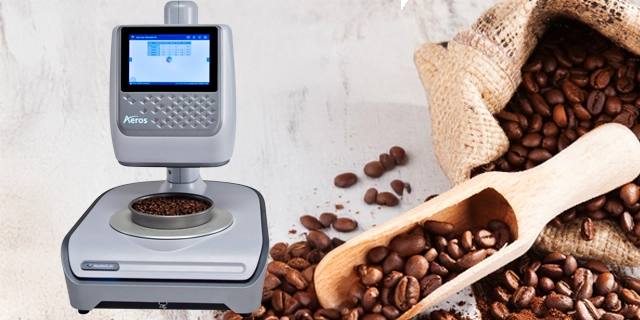
Aeros measuring coffee beans

The initial conversation centered on the ColorFlex L2 Coffee, HunterLab's dedicated color spectrophotometer for ground coffee. But by listening carefully to how the roasting lab actually operated, a stronger fit quickly emerged: the Aeros, designed specifically for whole roasted beans.

The distinction matters significantly in a production context. Grinding changes the sample, adds a preparation step, and introduces contamination risk. The Aeros eliminates all three issues.

Why the Aeros was the right fit

  • Whole roasted beans placed directly on the HunterLab color spectrophotometer Zero sample preparation
  • One touch, done 5 seconds, 35 measurements, 27.5 square inches of sample measured
  • More representative results per batch Large measurement area
  • No grinding required No microbial contamination risk
  • Aligned with CIELAB roast classification Instant L*, a*, b* output

Note on the ColorFlex L2 Coffee: For operations requiring post-grind analysis, SCAA Roast Value reporting, or, the ColorFlex L2 Coffee remains the industry benchmark. Its 45/0 geometry replicates exactly how a trained technician views ground coffee, and its dual SCAA plus CIELAB reporting bridges legacy and future standards in a single measurement.

INFO  Get More Information
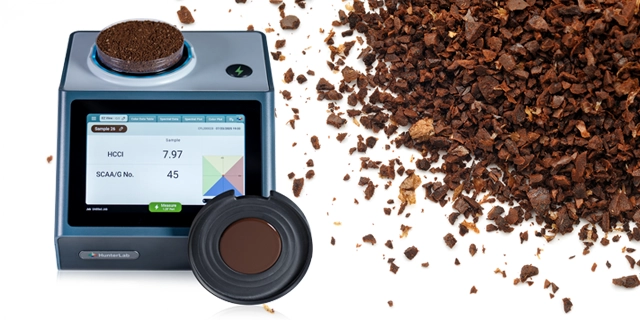
ColorFlex L2 measuring grained coffee

Results: A Data-Driven Foundation for a Premium Brand

With the Aeros in operation, the roaster now has the objective color measurement infrastructure to support consistent, traceable, and scalable quality control across every batch.

Frequently Asked Questions About Coffee Roast Color Measurement

How do you measure coffee roast color objectively?
The most accurate method is full-spectrum CIELAB spectrophotometry using L*, a*, b* values. The L* axis measures lightness (roast depth), ranging from approximately 55 for very light roasts to 18 for espresso. The a*axis captures the reddish-brown hues from the Maillard reaction, and b* reflects the yellow-to-brown shift in early roasting. The HunterLab Aeros measures whole beans without grinding; the ColorFlex L2 Coffee measures ground coffee with simultaneous SCAA Roast Value and CIELAB output.


What is the CIELAB roast color scale for coffee?
In CIELAB space, roasted coffee spans an L* range from approximately 55 (Very Light) to 18 (Very Dark/Espresso). UC Davis Coffee Center research published in 2025 confirmed that arabica coffee from different origins consistently maps onto a universal roasted coffee color curve in L*a*b* space, making it a reliable, HunterLab color spectrophotometer-independent standard for roast classification.


What is the difference between the HunterLab Aeros and ColorFlex L2 Coffee?
The Aeros measures whole roasted beans directly: zero sample preparation, 35 measurements averaged in seconds, no contamination risk. It is designed for rapid in-process QC in roasting environments. The ColorFlexL2 Coffee uses 45/0 optics to measure ground coffee, delivering both SCAA Roast Value and full CIELAB classification simultaneously, making it the choice for formal SCAA compliance, research labs, and post-grind analysis and production workflows.


Why is visual roast color assessment not reliable enough for coffee quality control?
Human vision cannot reliably detect the small, early-stage color shifts that precede significant quality differences. Roast color changes of less than 1 L* unit can indicate meaningful differences in flavour development and antioxidant content. Subjective assessment also cannot provide the batch-to-batch traceability, repeatability data, or SCAA compliance documentation that premium coffee brands require.


Is SCAA the same as SCA?
The Specialty Coffee Association of America (SCAA) was founded in 1982 by a small group of coffee professionals to establish quality standards and promote specialty coffee. It grew into a leading trade organization, merging with the Specialty Coffee Association of Europe (SCAE) in 2017 to form the unified, global Specialty Coffee Association (SCA) [1, 2, 3]   As result the SCA no longer recognizes or produces the obsolete SCAA standards.  This does not prevent existing users to continue to grade coffee using these tools.


Does the SCA require objective color measurement for coffee grading?
Many competitors to HunterLab will claim to offer SCA Roast Color Classification but that is a lie. The SCA does not have a roast classification, roast degree or roast color specification.  Prior to the World of Coffee show in San Diego the SCA sponsored a technical conference to discuss standards development with the goal of publishing a standard by 2027.  This will be a CIELAB-based classification, but no details on how it will be used have been finalized.   The shift toward CIELAB-based classification provides a uniform, traceable, objective scale.


Ready to build your data-driven coffee roast color quality program?
Whether you are roasting 50 kg a week or 5,000 kg, objective CIELAB measurement using HunterLab color spectrophotometers eliminates the guesswork and gives your quality control program a defensible, data-driven foundation.


Contact a HunterLab Coffee Color Specialist  | info@hunterlab.com
Or request a product demo.