The Nature of Anthocyanin Pigments in Red Wine
“Anthocyanin pigments are responsible for the red, purple, and blue colours of many fruits, vegetables, cereal grains, and flowers…. There is considerable anecdotal and epidemiological evidence that dietary anthocyanin pigments and polyphenolics may have preventive and therapeutic roles in a number of human diseases. Through the much publicized “French paradox”, the public has become aware that certain populations of red-wine drinkers in France and Italy have much lower rates of coronary heart disease (CHD) than their North American and Northern European counterparts. It is widely accepted that red wine phenolics contribute at least partly to this beneficial effect…” [1]
How red wine colour changes over time relative to its original colour is an important quality correlate to wine chemistry. The sweet time spot is typically around 20 years and colour consistency to that point is important. Over time anthocyanins (mostly found in the skin of red grapes) change in colour, starting as a deep red and gradually becoming a fine ruby red at 20 years. After 100 years, red wine will be a desaturated yellow as the anthocyanin colorants polymerize. [2] [3]
As anthocyanins in red wine age with time, they break down to phenolics, which are also red pigmented, but not the same red. In addition, the breakdown of anthocyanins by oxidation occurs, creating yellow by-products. [4]
Traditional Metrics for Colour Analysis of Red Wine Colour [5]
Academic articles in food science tend to use CIE L*, a*, b*, C*, h D65/10 to measure wine colour as this colour scale can be used to measure any colour.
There are also a couple of traditional metrics based on spectral data that are used to quantify red wine colour over time.
- Undiluted wine is typically filtered (2 micron filter) to remove any residual solids.
- The wine sample is verified as being at a natural pH level prior to colour measurement.
- A 10 mm path length transmission cell is typical used to measure light reds, rosés and most whites. Extremely deep reds may require a transmission cell with a 2 mm path length.
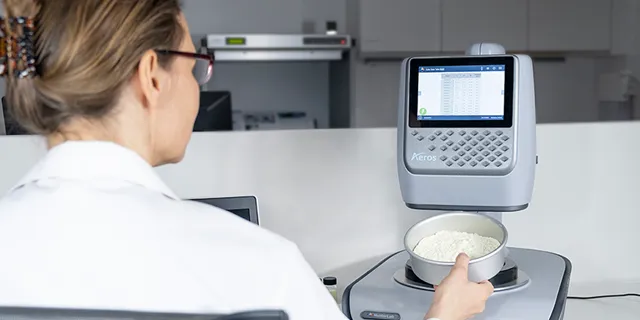
Standardize a CIE diffuse d/8 sphere instrument in Total Transmission mode using a transmission cell + DI water to set all spectral values across the visible spectrum to 100% transmission.
As a PQ Performance Qualification step, read back the cell + DI water and verify transmission at 420 and 520 and 620 nm wavelengths = 100% closely.
Fill cell with wine and measure spectral transmission [%], then convert to absorbance values, sums and ratios as follows:
- A420-nm and A520-nm and A620-nm
- Absorbance at A420-nm + A520-nm
- A420-nm/520-nm
These spectral points are used in the calculation of tradition red wine metrics based on the Sudraud Method.
Red Wine Colour Intensity (also called Red Wine Density) = A420-nm + A520-nm
Red Wine Colour Tone (also called Red Wine Hue and Red Wine Tint) = (A420-nm / A520-nm)
where: Absorbance at 520 nm will become lower as the red wine ages and oxidizes.
Lot-to-lot production colour differences are often measured in CIE dL*, da*, db*, dC* dH, dE*, dE2000 D65/10, along with Haze% to measure scattering. [1]
- CIE L*, a*, b* D65/10 (of all illuminants, D65 shows purple values in wine the best).
- C* chroma is indicates the amount of colour.
- h hue angle indicative of a hue shift.
- dE* total or dE2000 elliptical colour difference relative to seasonal average or fixed standard colour.
FAQ: “Can you analyze the colour of turbid or cloudy wines?”
The scattering of light by internal scattering centers can interfere with accurate colour measurement. Sphere-based colorimetric instruments are robust in measuring the colour of wines that are transparent in colour but may exhibit some slight scattering.
Particulates in turbid wine samples, such as fermenting wines, can be centrifuged. If very turbid (some grape juices), filtration after centrifuging may be required. [2]
If slight scattering in a transparent wine is a quality concern, this can be measured as Haze% or in correlated NTUs on a sphere colorimetric instrument.
FAQ: “There has been reference to using an NIR instrument to measure the concentration of anthocyanin which apparently can be measured in the NIR but visually shows up as the degree of redness or “colour” in wine and grape juice. Can you tell me something about this?” [3]
See Red Wine Colour Intensity and Tone.
FAQ – “Are there any visual standards for wine that can be used to check a colorimetric spectrophotometer?”
There are no industry colour standards for wine. The only suggestion I can make is to purchase glass filters from a glass supplier with similar L, a, b values to wine colour being measured. These colored filters could be used to monitor instrument performance over time in the wine colour region of colour space, adding confidence in the wine colour measurements. [4]
FAQ: “What is the difference between the 420:520 ratio measurement of hue and CIE hue angle?”
The 420:520 hue ratio is based on two wavelengths: the 420 nm for indicating yellow and the 520 nm for red. In contrast, the CIE hue angle is based on the entire wine spectra. Hue angle is more descriptive of colour nuance and, as a result, is more sensitive to subtle changes in wine chemistry and a more accurate representation of colour present. What’s more, the CIE hue angle can describe any colour. The 420:520 hue ratio is only appropriate for red wines. [5]
FAQ: ”Can you compare the same wine at two different dates?”
Yes, wine colour information can be stored in a database, then retrieved for comparison against itself at different points in its life cycle of the product. The key lies in the goal and the timing of the initial sample. For colour development at the winery, a good time to sample is when the wines are going to barrel. For tracking changes in colour after shipment, samples should be taken at bottling. [6]
Commercial Testing Lab for Wine Colour
ETS Laboratories,
St. Helena, CA USA
www.etslabs.com
References that cite Wine Colour
Pérez-Caballero, V., F. Ayala, J.R. Echávarri, and A.I. Negueruela. 2003. Proposal for a new standard OIV method for determination of chromatic characteristics of wine. Am. J. Enol. Vitic. 54:59-62.
There are some OIV methods in the Compendium of International Methods of Analysis of Wine and Musts – search on “wine colour” at www.oiv.int .