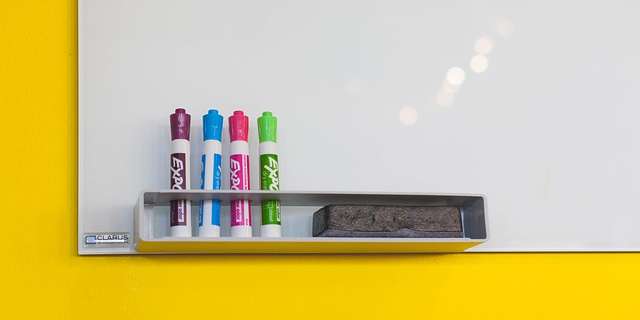
When dry erase markers hit the U.S. mainstream market in the 1990s, they were instantly popular among scientists, teachers, and engineers.1 Unlike chalk, which was messy, difficult to write with, and hard to clean, dry erase markers were far more convenient for consumers—they could write on the same surface hundreds of times without leaving behind streaks of colour or chalk dust. Today, dry erase markers are still one of the most popular writing tools in the world. But in order to attract customers, marker manufacturers need to use an effective colour quality control protocols to test their products for opacity and erasability. Because dry erase markers are so popular, only the brightest-colored and most erasable products are able to compete. By evaluating your products from the start, you’ll attract more customers in this fiercely competitive industry.

How to Measure Slippery Polymers

When you measure the colour of permanent markers, you simply swatch the colour onto a sheet of white paper and analyze it using a spectrophotometer. In theory, a dry erase marker can be measured using the same technique. However, in practice, dry erase markers present unique challenges that must be accounted for during the measurement process.

Unlike permanent or wet erase markers, which are made with a mix of colour pigments and acrylic polymer, a dry erase marker uses a silicone-based polymer instead.2 This type of polymer is oily and extremely slippery, and it’s this oily quality that gives the ink its erasability. While other acrylic polymers stick to porous surfaces, a dry erase marker’s ink is more likely to slip right off of glass or whiteboard material. If properly formulated, it only stains if you leave the ink on the surface for a great deal of time (usually weeks or even months after the original application).

Although this slipperiness is a sign that your dry erase marker is high-quality, it also makes it more difficult to test your marker colours with the colour measurement procedures used for other types of markers and special care must be taken during the measurement process. Instead of measuring the colour on paper, you’ll need to do a swatch test on a sample of whiteboard, then analyze this sample using your spectrophotometer. However, because the ink is so slippery, if you graze the colour swatch against the spectrophotometer, you may accidentally wipe off most of your sample before it can be tested. As such, it’s essential to use a non-contact instrument that avoids direct contact with the sample and take care to avoid manually disturbing the sample. Many spectrophotometers are capable of measuring colour without directly touching the sample, and these will be the most effective tools for you to keep in your lab.
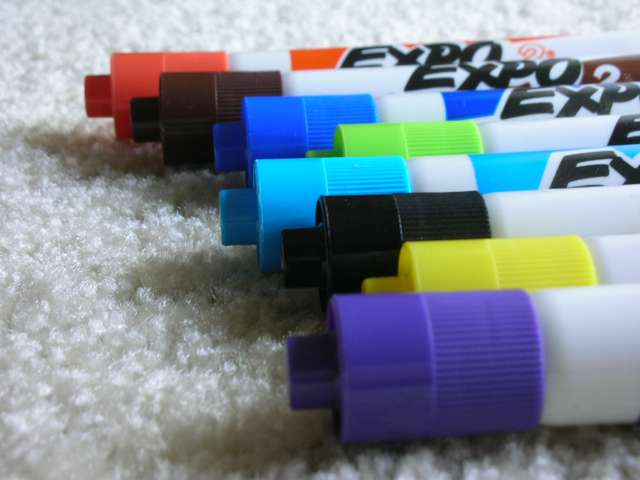
dry-erase-markers-2.jpg

Light-colored dry erase markers, like yellows, greens, and light blues, are more challenging to test because they aren’t as opaque or densely pigmented as darker colours. Image source: Flickr user upsidedownsphere

Read  Temperature Effects on Colour Measurement: Maintaining Accuracy in Extreme Conditions

Compare Whiteboard Swatches to Cap Colours

Once you’ve accounted for your dry erase markers’ slippery ingredients, you’ll also need to ensure that your ink colours match the marker’s cap. When customers shop for dry erase markers, they often can’t test the marker before they buy the package. Your customers have to rely on the marker’s cap and other packaging components to tell them which colours they’re purchasing; if your customer buys your product and finds that your red marker actually appears more orange after application, they may choose to shop with a different marker company in the future. The most successful dry erase marker companies are able to closely match their cap colour to their ink.

To do this properly, you’ll need to start by measuring your ink colour. Once you know the exact shade of the ink swatched on a whiteboard, you can craft custom marker caps that will match the shade of the ink perfectly. This process is too difficult to perform using the human eye alone. To start, your eye may have difficulty comparing a two-dimensional colour swatch to a three-dimensional marker cap, and poor lighting or other colour biases could impact the accuracy of your chosen cap colour. By putting an exact shade number onto your product and creating a custom shade perfectly matched to that numbered colour, you ensure that your customers always get the colour that they expect. This is an especially useful tool for light-colored markers, as these can be particularly for the human eye to differentiate against different colored surfaces. A yellow shade, for example, may appear darker than it actually is when it’s placed against a black sample background, which may result in an incongruent marker cap colour that’s too dark.3 By using a spectrophotometer, the exact shade of yellow will be detected, even if your eye sees a darker shade.

dry-erase-markers-3.jpg

It’s important for a marker’s cap to closely match its ink so that consumers can make more informed choices about the colours they’re buying. Image source: Pixabay user AlexanderStein

INFO  Get More Information

Ensuring Erasability

Your ideal colour quality control protocols will include not only ink colour measurements and cap colour matching, but erasability tests. To start, you should use a spectrophotometer to test the opacity and colour saturation of your ink against its most common application surface (a whiteboard). You may also decide to test it against other surfaces, such as glass, mirrors or dark-colored dry erase boards. Once you find an ink colour that appears well-saturated against all of these surfaces, you should test whether your ink still erases properly. Sometimes, when you add pigments to a marker to achieve better saturation, you also increase the risk of staining the surface. To test this, you should use a spectrophotometer to compare test samples before and after erasure. A high-quality spectrophotometer should be capable of detecting even the faintest ink residue leftover after erasing the sample, which will tell you whether your product is slippery enough to erase fully after application.

HunterLab Reliability

For more than 60 years, HunterLab has been a leader in colour measurement technologies, providing the most accurate spectrophotometers to companies that work with ink-based products. Today, we provide solutions for pen manufacturers, art supply providers, and many others who rely on accurate ink colour measurements. Our staff can help you find the best spectrophotometer for your needs and teach you how to use our built-in colour measurement scales to ensure that every dry erase marker you craft meets your customers’ high standards. Contact us today to find out more about creating the best colour quality protocols for your dry erase markers.