
The human eye can perceive millions of colours, but it does not always distinguish them accurately. Two slightly different colours may appear the same, or identical colours may look different depending on viewing angle and lighting. This creates challenges when communicating about colour. For designers and manufacturers, the inability to precisely identify and communicate colour complicates efforts to replicate standards and detect discrepancies.
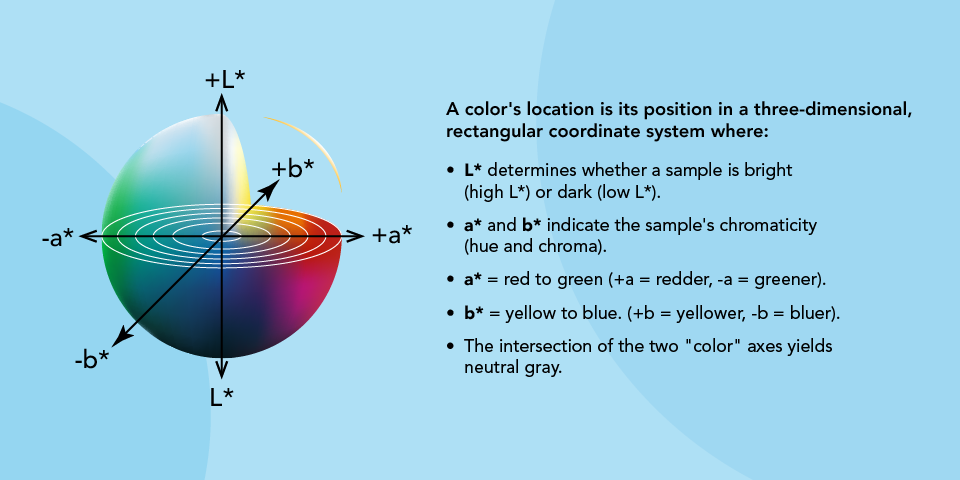
To reproduce an exact colour consistently, manufacturers and designers rely on ways to quantify a colour's properties and calculate the numerical difference between colours. CIELAB, or CIE L*a*b*, is a device-independent, three-dimensional colour space that measures and compares all perceptible colours using three values. In this space, numerical differences correspond to the degree of change humans can perceive.
CIELAB is based on opponent colour theory showing that the brain interprets retinal inputs as differences between light and dark (lightness) and between opposing pairs of colours: red/green and blue/yellow. This is known as the principle of colour opposition correlation, as a colour cannot be both red and green, or yellow and blue, simultaneously. For example, you will never see a "greenish red.
What Is the CIELAB Colour Model?
The L, a, b colour space was first defined in 1942 by Richard S. Hunter, founder of HunterLab. Hunter’s system used coordinates labeled L, a, and b, calculated from the CIE 1931 XYZ colour space, and was intended to be more perceptually uniform. In 1976, the International Commission on Illumination (CIE) created the CIELAB model as a refinement of Hunter’s work. To distinguish between the two systems, CIELAB uses L*, a*, b* notation. The “CIE” refers to the French name of the organization: Commission Internationale de l'Éclairage.
Both Hunter L, a, b and CIELAB (L*, a*, b*) are grounded in Opponent-Colour Theory, which assumes that the human eye perceives colours in opposing pairs:
- L scale: Light vs. dark, with low numbers (0–50) indicating dark and high numbers (51–100) indicating light.
- a scale: Red vs. green, with positive values indicating red and negative values indicating green.
- b scale: Yellow vs. blue, with positive values indicating yellow and negative values indicating blue.
An ideal colour scale would be uniform, meaning that a one-unit difference would appear visually equal regardless of hue. In practice, neither Hunter L, a, b nor CIELAB is perfectly uniform. Hunter’s scale applies a square root function to Y/Yn for calculating lightness (L), which tends to compress values in the yellow region and expand them in the blue region. CIELAB, by contrast, applies a cube root function to X/Xn, Y/Yn, and Z/Zn, with a linear extension near black. While this improves uniformity overall, CIELAB tends to over-expand the yellow region of colour space. Both scales are effective for measurement and for setting tolerance standards. However, CIELAB generally provides a closer match to visual perception. With practice, either system supports intuitive understanding and communication of colour values.