HunterLab
  • Products
    • Benchtop Spectrophotometers
    • Portable Spectrophotometers
    • Quality Control (QC) Software
    • In-Process / In-Line
  • Industries
    • Food
    • Beverages
    • Plastics
    • Chemicals
    • Bio-Pharma
    • Building Products
    • Paints & Coatings
    • Paper
    • Textiles
  • Learn
    • Measurement Methods
    • Glossary
    • Application Notes
    • Customer Stories
    • Product User Manuals
  • Company
    • About
    • History
    • Careers
  • Resources
    • Blog
    • Certifications
    • Customer Stories
    • Video Gallery
  • Contact
    • Support Website
    • Support, Services and Parts Queries
    • Product Queries
    • Our Location
  • Get Quote
  • Search
About
BLOG

Interested in a little light reading?

Our blog is continually updated with helpful educational information, advises, research and insights—all in the name of helping you level-up your colour and appearance needs. Grab a drink and enjoy our stories!

Explore Stories

"What Is Colour Stability and Why Is It Important?"

Read

Explore Our Products

View More

"Do you have references for the equivalency of CIE inverse instrument geometries?"

Read

"Do you have a source for Magnesium Carbonate powder as top-of-scale?"

Read

"Do you have a source for calibrated, traceable transmission filters?"

Read

"Sources for BRDF and BSDF Equipment and Testing Services"

Read

"Does Colour Perception Change Over Time?"

Read

"Is there a Munsell HVC colour conversion in EasyMatch QC?"

Read

What Is Colour Stability and Why Is It Important?

Posted on May 07, 2025 by HunterLab

Colour is one of the first sensory processes humans experience. It can alert us to potential danger, like the orange of a safety cone, or tell us what flavor we might expect from a piece of candy.

Long-term changes to colour appearance can have negative impacts — a dusty pink fire engine isn't going to draw attention as effectively as a bright red one. Learning about colour stability and understanding its importance, challenges, and the best way to ensure it can help you prevent unwanted deviations from the intended, expected, and desired results.

Defining the Stability of Colour

In its simplest terms, colour stability refers to how well a material can maintain a consistent colour throughout its life span. 

It's important to note that colour stability substantially differs from colour consistency and constancy. While maintaining those traits is also vital, these terms refer more to eliminating chromatic variations across batches, production lines, facilities, and observation conditions like illumination.

Factors That Can Impact Colour Stability

Multiple factors can cause alterations in chromaticity as time passes. As a result, changes can arise during any manufacturing stage and throughout material storage and distribution. Excess exposure to the following can impact colour stability:

  • Moisture
  • Oxygen
  • Light and UV rays
  • Extreme temperatures
  • Chemicals

The Importance of Colour Stability

Maintaining colour over time is vital for several reasons.

Quality

Colour and quality are inherently intertwined. Chromaticity that meets a consumer's expectations encourages them to form a positive brand image. When colour conforms to industry standards, it also showcases your company as one committed to best practices. Colour stability helps support these outcomes by ensuring long-lasting durability, which boosts perceived value.

Safety and Compliance

In many products, colour stability goes hand in hand with safety. Consider goods like reflective safety tape, camouflage military uniforms, and edible oils, where colour alterations over time can impact visibility or indicate potential contamination that would make it unsafe for consumption. Additionally, products whose colour maintains acceptable tolerances in highly regulated industries prevent unnecessary fines or penalties.

Appeal

Customers may see colour as the primary determinant in their purchasing decisions for certain items, like vinyl siding and roofing shingles. Remodeling a home exterior is a significant investment that consumers expect to last for years. Customers don't just want it to look good now — they want to know the colour they see at first is the colour they can expect it to stay, even after long-term exposure to the elements. 

Posted in Color And Appearance Theory

Do you have references for the equivalency of CIE inverse instrument geometries?

Posted on Nov 29, 2023 by HunterLab

FAQ: “…. the schema of the principle of measuring shows other way of light (source of light -> sample -> sphere -> detector) than our Vista (source of light -> sphere -> sample ->  detector). Please can you explain me difference between both construction? difference between both results of measuring?”

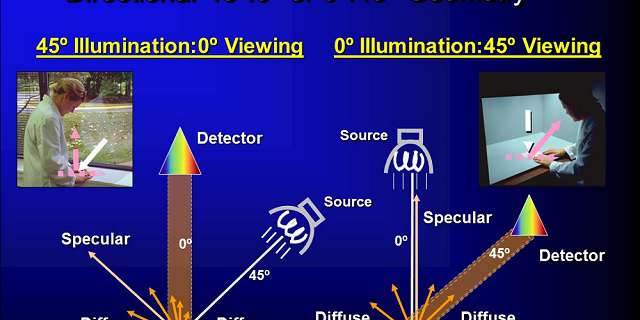
This describes the concept of equivalency of inverse geometries for colour measuring instruments in reflectance where the source of light -> sphere -> sample ->  detector in a CIE diffuse d:8 geometry is equivalent to the source of light -> sample -> sphere -> detector of an 8:d geometry. The same concept applies to CIE directional 45:0 and 0:45 geometries.

An instrument with directional 45:0 geometry on the left matches the viewing condition of the technician at the window, and is equivalent to the 0:45 geometry on the right matching the technician viewing samples in the light box.

When you look at a sample colour, the colour you perceive is dependent on the geometry of how you look at it – where source of white light is; where you are standing and where the sample is.

To measure a colour as you perceive it, the instrument geometry must match the way you view the sample. A CIE instrument geometry is a formal definition of the relative positions of the light source, sample plane and detector to each other.

There are two main categories with 2 equivalent geometries each – diffuse d:8 (most common) and 8:d and directional 45:0 (most common) and 0:45.

Posted in Color And Appearance Theory

Do you have a source for Magnesium Carbonate powder as top-of-scale?

Posted on Nov 29, 2023 by HunterLab

Transitioning from Magnesium Carbonate to PRD Perfect Reflecting Diffuser for Reflectance Calibration

For measuring the brightness of some materials, some dated industrial methods cite a Magnesium Carbonate block standard to be set to Y = 100% in reflectance. This is a very old top-of-scale standard and HunterLab does not recommend using it.

Instead users should update their methods to the current industry standard of a PRD Perfect Reflecting Diffuser as 100% top-of-scale for reflectance. A Magnesium Carbonate plaque will read slightly lower than a PRD standard, typically around 97%.

If you are determined to use a Magnesium Carbonate top-of-scale, a source for Magnesium Carbonate powder that can be pressed into a plaque can be found at:

Magnesium Carbonate, Pentahydrate, white powder
(Magnesite, Carbonic Acid Magnesium Salt)
4Mg(CO3)•Mg(OH)2•5H2O

Fisher Scientific
Pittsburgh, PA USA
www.fishersci.com
Product # S25399

Posted in Color And Appearance Theory

Do you have a source for calibrated, traceable transmission filters?

Posted on Nov 29, 2023 by HunterLab

HunterLab does not supply glass or plastic filter transmission standards but here are some sources.

HunterLab would always encourage a client to regularly use the diagnostic options that come with our sphere instruments to verify instrument performance over time.

  1. Short Term Repeatability on the White Tile to verify the instrument electronics are in good health.
  2. Green Tile Test for verification that the instrument has not changed in long term photometric performance.
  3. Didymium Filter Test for verification that the instrument has not changed in long term wavelength performance.

Additional transmission filters can provide an extra level of validation particularly related to the measurement of transparent solid samples (go here for transparent liquid standards). Here are three situations where having one or more additional transmission filters could be helpful:

  1. When your product is a transparent solid, having a more stable, durable, cleanable and uniform glass filter to serve as a PQ Performance Qualification check filter can validate the measurement process. Each day, after standardization, operators can read the check filter and compare to baseline values measured in the same colour scales as the product. If the read values match the baseline values closely, the operator and instrument are performance qualified to proceed to measure production samples.
  2. Additional confidence in the measurement process can be gained by measuring the colour of a uniform glass filter, similar in colour to the product, over time. It does not have to be the same colour, just in the same area of colour space. Documenting the filter results over time helps verify that the product colour you measure today is the same as measured weeks, months or years ago.
  3. When you are conducting an inter-instrument agreement study of transmission colour measurements taken on a transparent solid product at multiple sites, inclusion of a glass filter can allow outlier sites to be easily spotted. The glass (best) or plastic filters will be more uniform and stable than the product. All sites should agree closely on a uniform glass filter of similar colour as the product. If not, the usual problem is that outlier sites do not have their instrument configured correctly for the measurement. If a site is an outlier on the check filter, their product measurements are also suspect. Stopping the test at this point and figuring out what is wrong is the best path forward.

Posted in Color And Appearance Theory

Sources for BRDF and BSDF Equipment and Testing Services

Posted on Nov 29, 2023 by HunterLab

In industrial colorimetry of QA non-luminous materials, assumptions are made that light reflected from or transmitted through a surface is relatively uniform, with only diffuse and specular components. To promote inter-instrument agreement, the CIE geometries for collecting the reflected or transmitted signal of non-luminous materials are standardized into directional and diffuse sphere types.

Prismatic highway signage materials tend to reflect light more in a retro-reflective direction than in any other. This is the type of material where a BRDF scattering profile would be useful to know in the research stage.

Posted in Color And Appearance Theory

Does Colour Perception Change Over Time?

Posted on Nov 28, 2023 by HunterLab

Every person perceives colour differently. A unique combination of genetics and circumstances influences each individual's connection to and view of various hues. If you've ever had the experience of talking with an older adult and disagreeing on the colour you're both seeing, you may find yourself questioning whether colour perception changes with age — and sometimes, it can.

Differences in Colour Perception

Some of the reasons you may perceive a different colour than the person next to you may include:

  • Genetics: The most well-known reason for differences in colour perception is genetics. Colour blindness affects one in 12 men and one in 200 women, usually due to a genetic marker in the X chromosome.
  • Culture: Different geographical locations place varied emphasis on colours, combining hues like blue and green or navy and black into one word in their languages. Some languages have even more words to describe different shades.
  • Trauma: Occasionally, injury or illness can bring on partial blindness or colorblindness that affects colour perception. Common causes include brain or eye injury or an illness like diabetes.
  • Age: While your perception of colour may remain the same for most of your life, your eyesight can begin to change and deteriorate as you age. Some people develop a yellowish tint to their vision, most often after age 70, which can affect their ability to differentiate between shades of yellow, blue, and green.

Posted in Color And Appearance Theory

Is there a Munsell HVC colour conversion in EasyMatch QC?

Posted on Apr 20, 2023 by HunterLab

FAQ: “Do you offer a Munsell HVC colour conversion in your EasyMatch QC software?”

The Munsell HVC or Hue Value Chroma colour scale is a visual reporting scale based on paint and plastic chips not as precise as colorimetric scales such as L*, a*, b*. The HVC values are the designation of the nearest Munsell Colour chip that matches a sample colour.

Think of colour communication as being at 3 levels:

  • Word descriptors – “What is Salmon Pink?” Words often mean different colours to different people and it is both a subjective and imprecise means to communicate colour.
  • Visual Colour Standards – These usually feature colour chips of some type like Munsell, Pantone, Natural Colour Systems, RAL, Fed Std 595c.The best ones cover most of colour space and are arranged in a systematic manner. These visual colour standards do provide a physical representation (paint or plastic chip) of the colour. The chip chosen is closest to the target colour but there may be a visual difference such as when surface characteristics differ.  Although still subjective, these visual colour standards are better than words as a colour reference.
  • Colorimetric Measurements – Measure the actual product in a precise and objective manner using colorimetric instruments and colour scales.

FAQ: “Is there an easy way to report Munsell HVC values for my product colours?”

HunterLab does not offer a Munsell HVC Colour conversion in our software, but there are other options.

Wallkill Colour offers two cost effective options for reporting Munsell Colour:

  1. Free Excel file of 2352 Munsell colours with corresponding colour values that you can search to find the nearest Munsell colour and report it.
  2. A software conversion program available for reasonable $ where you can enter or cut-and-paste colorimetric values from EasyMatch QC and have the program report the corresponding Munsell colour values.

Another good site by Bruce Lindbloom for visualizing the display of Munsell Colours as a visually uniform colour space.

Posted in Color And Appearance Theory
Prev
1
2
3
…
Next

Most Related Posts

  • What Is Colour Stability and Why Is It Important?
  • Do you have references for the equivalency of CIE inverse instrument geometries?
  • Do you have a source for Magnesium Carbonate powder as top-of-scale?
  • Do you have a source for calibrated, traceable transmission filters?
  • Sources for BRDF and BSDF Equipment and Testing Services
  • Does Colour Perception Change Over Time?
  • Is there a Munsell HVC colour conversion in EasyMatch QC?
View More

Follow Us

  • LinkedInFollow us on LinkedIn
  • YouTubeFollow us on YouTube
  • facebookFollow us on Facebook
  • XFollow us on X (formerly Twitter)
  • instagramFollow us on Instagram

HunterLab

703.471.6870

Corporate Headquarters
11491 Sunset Hills Road
Reston, Virginia 20190

  • Products
    • Benchtop Spectrophotometers
    • Portable Spectrophotometers
    • Quality Control (QC) Software
    • In-Process / In-Line
  • Industries
    • Food
    • Beverages
    • Plastics
    • Chemicals
    • Bio-Pharma
    • Building Products
    • Paints & Coatings
    • Paper
    • Textiles
  • Learn
    • Measurement Methods
    • Glossary
    • Application Notes
    • Customer Stories
    • Product User Manuals
  • Company
    • About
    • History
    • Careers
  • Resources
    • Blog
    • Certifications
    • Customer Stories
    • Video Gallery
  • Contact
    • Support Website
    • Support, Services and Parts Queries
    • Product Queries
    • Our Location

Get in touch

  • Instagram
  • Facebook
  • LinkedIn
  • Twitter
  • Certifications
  • Terms and Conditions
  • Privacy Policy
  • Sitemap
  • Code of Conduct