

Today’s sunglasses are much more than just a fashion accessory. New research in lens technology has revealed that visual perception is greatly influenced by both colour and quality. Image Source: Pexels user Pixabay

Whether skiing on a mountain or boating on the lake, protective eyewear is more than just a fashion statement. For many years I had relied on dime-store glasses to dull the glaring effects of the sun. While they seemed to do the job at a fraction of the price, I really hadn’t experienced the difference in quality protective eyewear. My husband, on the other hand, is somewhat of a sunglass snob. Always wearing the designer brand and latest fashion, I assumed he was more interest in appearance than performance…that is until I tried his on. Only one word can describe it, WOW! The quality lenses and polarized coating changed my view of the word, literally. No more cheap glasses for me. When it comes to protective eyewear, quality is worth every penny.

Not only does my husband enjoy top brand sunglasses, he also seems to have a pair for every type of activity we enjoy outside. The golden yellow lenses for the water, the reflective lenses for the mountain, and standard gray for the golf course. I thought this was merely another of fashion statement he was going for, but after some research, I found that colour really does play a significant role in the performance of sunglasses.

sunglass-lens-color-4.jpg

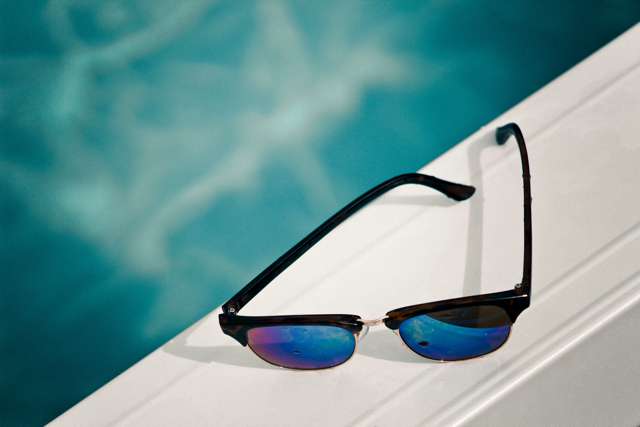
The lens colour, tint, and/or reflective coating can all change visual perception based on environmental lighting conditions. Image Source: Unsplash user Tiko Giorgadze
Read  Colour Variations in Plastics: You Say Lime, I Say Chartreuse -- What Is It Really?

Colour and Performance in Sunglasses

The human eye perceives colour by the amount of light that is reflected or absorbed by an object. “Of all the light waves interacting with our eyes, those at the blue end of the light spectrum are most powerful. Cones in the eye’s retina read colour, and it’s the blue light that dominates our vision, washing out our perception of other colours. Minimizing this blue light and enhancing other colours, such as red and green, is said to improve visual acuity.” Andy McSorley of Oakley Sunglasses and Apparel explains how “colour perception varies from person to person [and] is solely opinion-based”. However, “specific colored lenses do perform better in certain conditions.”1

Light transmission and colour shifting both play an important role in visual perception when various lighting conditions exist. Neutral or gray lenses block out the most light, creating a darker effect than colored lenses. Although transmission values remain the same, consumers tend to prefer these lenses based on visual effect. Amber or bronze lenses create a colour shift by blocking more blue light. This increases contrast, which can improve the visibility of water surfaces, where one colour dominates the majority of the viewing area. Yellow lenses are also used to block blue light and improve brightness in low-light conditions. These lenses display a higher transmission rate to create a brighter viewing experience. Anti-reflective lenses typically use a reflective blue-mirrored coating to reduce glare, creating more clarity in brighter blue conditions. By using a spectrophotometer to monitor lens colour and transmission values together, protective eyewear lenses can be formulated to meet consumer needs based on specific environmental factors.

sunglass-lens-color-3.jpg

Anti-reflective coatings are a popular choice for bright blue skies and water. Image Source: Unsplash user Joseph Greve

INFO  Get More Information

Measuring Colour and Transmission Values

Plastic is the most commonly used material in sunglass lens production, due to safety, cost, ease of production, and superior optical quality. Spectrophotometers measure colour throughout the manufacturing process of sunglass lenses to guarantee quality and performance. Colour analysis begins with QA testing of the liquid polymer ingredients to improve clarity and colour consistency throughout production. Colour measurement instrumentation is also used to measure polarization films and anti-reflection coatings to ensure lot-to-lot tint characteristics remain consistent.

Spectrophotometers with advanced sphere technology address specific attributes such as glare by controlling all factors of light including reflection, transmission, observation angle, and light source.2 This allows for accurate measurements throughout every stage of production to improve both quality and piece-to-piece consistency. Clear and tinted lenses, as well as formed polarizers that are transparent, are best measured using total transmittance mode on a bench top sphere instrument for accurate assessment of colour when light shines through the finished product.

Addressing Challenges with Advanced Instrumentation

The non-uniform characteristics of transparent lenses can create some challenges when it comes to measuring colour. Compensation in preparation and presentation techniques is necessary to ensure a repeatable sample measurement. Because lenses are curved, instrumentation with the ability to measure a small diameter at the center of the lens is required to create a flattened surface. Imperfection in lenses such as bubbles, scratches, or hazy areas can also alter colour measurements. Instrumentation with the ability to average several readings with rotation is needed to account for these variations and achieve accurate results.

HunterLab is a leading name in protective sunglass lens colour and tint measurement. From the assessment of raw materials to final product evaluation, our spectrophotometers offer the most advanced technology needed to help maintain colour consistency and quality throughout production. Our goal is to help our customers develop a high-level product that with increased value and sales. With over 60 years of experience in the plastic and coating industry, we understand the needs and challenges of this market. For more information on how spectral analysis can ensure quality and take your product to the next level, contact us today.

  1. “Lens Colours Decoded”, April 14, 2016,   http://www.sailingworld.com/gear/lens-colours-decoded
  2. “Measuring Lenses with UltraScan Pro”, 2017, https://www.hunterlab.com/mm-5057-measuring-lenses-with-ultrascan-pro.pdf