
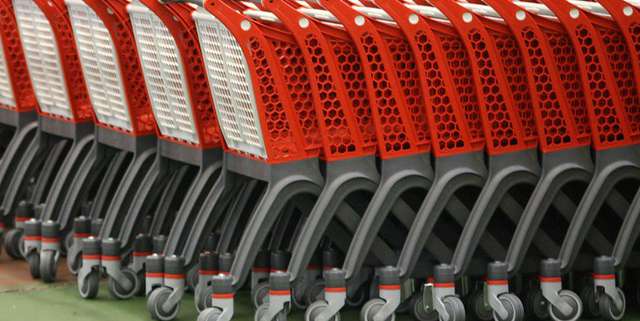
Plastic is ubiquitous in our society, and much goes into the creation of its various colours, hues and vibrancies.
Image Source: Flickr user Polycart

Plastics come in a variety of colours that attract and inspire consumers with their ability to add vibrancy, uniqueness or beauty to base colour resins that fall somewhere on a monochromatic scale from clear to various shades of natural to black. The colours of plastics can also signify a favorite brand or corporation logo, thus beckoning a consumer to purchase whatever the plastic holds. But achieving a sea green or a luminous blue requires carefully calibrated techniques that must be repeated by companies on very large scales at multiple, international locations in order to maintain colour consistency and thus a company’s desired message.
Read  Colour Variations in Plastics: You Say Lime, I Say Chartreuse -- What Is It Really?

Methods for coloring plastic
In order to colour plastics, companies often use four types of coloring methods. The first is called the “masterbatch” method in which pellets of natural colour are mixed with a material with a very high pigment content (masterbatch). The two components are then mixed and molded and then the final product is created from that mold.

1406396267_bb180c8fe4.jpg

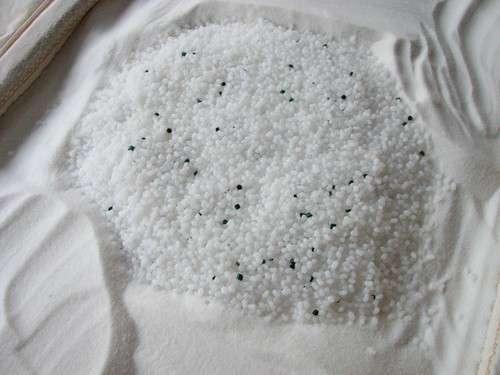
Plastic pellets to be colored via the masterbatch method, a popular technique for coloring monochromatic resin pellets.
 Image Source: Flickr user Windell Oskay

In the compounding method, pellets are mixed with pigments in an extruder to create colored pellets, which are then molded into a final product. Similarly, in the pigment solvent method, the pigment is dissolved in a solvent that is sprayed on the surfaces of natural pellets to also create colored pellets, which are then molded. The final method not often used is called dry blending in which the natural plastic pellets and pigment are mixed and molded “as they are” and then used to create a product. The method used will depend on expenses and the extent of pigment desired in the final products.

INFO  Get More Information

How to maintain colour consistency

3081880768_1bb4f9fae1.jpg

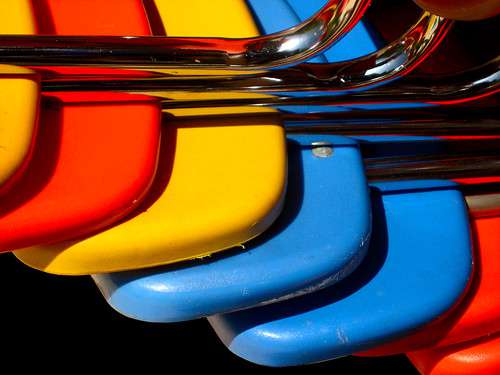
Choosing a colour is an essential part of the design process and thus, determining when and how to measure colour helps to maintain colour and design consistency.
Image Source: Flickr user Bill Gracey

Colour is essential to the design process and selecting the methods and colorants for this process are essential for consistency. The key is to think about colour early on in the product development process and to use spectrophotometers at different stages in order to maintain colour consistency and to prevent the creation of a final product that will be rejected by customers.

As described above, manufacturers of plastic items can choose various methods for coloring plastic. However, final products are generally molded from either pre-compounded and colored pellets or masterbatch mixtures in which the base resin is mixed at 3% concentration. To maintain colour consistency, the colour of these pellets is molded into a plaque and then measured. However, if the plaque measurement step could be eliminated or the number of plaques made reduced and replaced by a step measuring the colour of the pellets, producers would save a significant amount of money in time and resources while maintaining colour consistency.

From measuring plastic pellets to monitoring the compounding process
Unfortunately, the measurements of resin pellet colour are not directly correlated to the final colour of a product given several mitigating factors, including whether or not pre-compounded pellets were used, the size of the pellets (which can often be non-uniform), mix ratios of masterbatches, as well as the characteristics of the resin pellets used and the final colour a manufacturer hopes to achieve. Still, measuring colored resins can be useful for comparing plastic pellet samples from different or even the same supplier to approximate colour consistency.

Beyond the measurement of plastic pellets, a series of on-line spectrophotometry instruments at HunterLab are capable of making real-time, on-line colour measurements of a product as it is produced, allowing manufacturers to at least decrease the number of plaques created from pellets in order to test for colour consistency and potentially correct any changes in colour consistency that occur during the production process. In a business where profits are often measured to the last penny, it is important to determine parts in the manufacturing process that can be reliably expedited, and the use of our instruments can facilitate this judgment. Contact HunterLab today to determine how our products can help plastic manufacturers make the most of their materials and funds.