
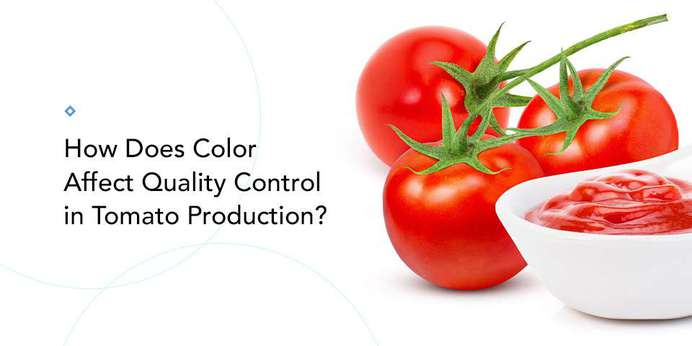
Tomatoes are essential in meeting global nutritional needs, improving health, and generating economic impact for communities worldwide. Billions depend on this crop — the second most grown vegetable on Earth — for better physical well-being and financial gain. As a result, colour is a critical factor in quality control for tomato manufacturing.

The Role of Colour in Tomato Quality Control

Tomato colour influences customer preference, quality perceptions, grading classifications, and market value.

Meeting Consumer Preferences

Assessing colour is one of the primary ways consumers make buying decisions. They see a tomato with a rich, red hue as a promise that it was harvested at the peak of freshness and flavor. Unripe ones and heirloom green varietals hint at a delightfully tart taste, perfect for a favorite Southern dish. Similar colour associations exist for tomato-based products, such as tomato paste and sauce.

Beyond taste, tomatoes are prized for their nutraceutical content — they're high in several vitamins and minerals, antioxidants, and fiber that offer physical benefits. The more their colour meets or exceeds customer expectations, the higher the consumer perceptions of the product's safety and quality. Increased confidence in those traits directly translates into a rise in purchase likelihood.

Conforming With Standards

Modern tomato processing facilities are covered entities under Title 21 of the Code of Federal Regulations, which subjects them to oversight by the Food and Drug Administration and the United States Department of Agriculture (USDA). As a result, they must follow Current Good Manufacturing Practices, which include measuring colour as part of quality assurance. The USDA sets colour tolerances for tomatoes to help determine their grade, meaning quantifying colour is essential for proper classification.

Those operating under voluntary frameworks may also need to evaluate colour for conformance with the guidelines. For example, the Safe Quality Food standards specify colour analysis as a vital quality assurance measure under several codes.

Leveraging Financial Potential

Businesses that thrive often do so by maximizing their profitability, and colour quality is a key driver in that quest. Generating high consumer quality perceptions through colour can help goods fetch premium prices, as buyers with increased product confidence are frequently willing to pay more for extra peace of mind.

For companies seeking to expand, colour quality becomes even more essential. Tomatoes and tomato-based products must meet specific standards to access new markets that can help spur organizational growth.

For example, the EU has multiple standards that apply to imported tomatoes and tomato-based products. These help establish the minimum grades acceptable for sale within the bloc, and colour is a primary determinant in that classification. Individual EU countries may also impose their own standards for the crop and its processed goods. Accurately quantifying colour to prove conformance with the standards makes it easier to access these high-value markets.


Read  Best Practices for Measuring the Colour of Safflower Oil

Factors Impacting Tomato Coloring

Many factors can affect the coloring and uniform ripening of tomatoes, including the following:

  • Growing conditions: The environmental conditions of growers substantially influence the crop's colour quality. These include traits like soil and water quality, rainfall frequency, and native pests.
  • Farming practices: Agriculturists' growing practices can affect colour, from the technology they employ to the techniques they use to seed and protect the crop.
  • Tomato strain: Certain varietals — especially popular heirloom tomatoes — naturally vary in colour, requiring colour measurement quality protocols capable of adapting to the differences.
  • Exposure to other elements: Undergoing exposure to extreme temperatures, more UV light, and increased oxygen can lead to enzymic browning, altering the colour of the final product.

The Best Ways to Ensure Tomato Colour Quality

The optimal way to ensure tomato colour quality involves three steps — measuring colour early and often, comparing it to accepted tolerances, and using the right approach to data capture.

1. Implement Frequent Measurement

Tomato farmers have several methods for deciding when to harvest the crop, with their ultimate goal being to deliver it to the consumer at maximum flavor, texture, colour, and quality. As a result, tomatoes may still undergo some ripening during transport and storage. 

Once they arrive at your facility, it's crucial to assess colour and ensure the vegetable meets acceptable tolerances before manufacturing starts. Each processing stage can also produce colour variations as tomatoes meet heat, light, and other production workflows. That means manufacturers must evaluate colour at every step of the process to control it effectively.

2. Choose the Right Tomato Colour Scores and Indices

Common scores and indices for tomatoes and tomato-based goods include the following:

Choosing the right comparison scores and indices for your specific application ensures your results conform to industry standards surrounding your product and can better meet consumer expectations.

INFO  Get More Information

3. Invest in Specialized Spectrophotometric Technology

Colour spectrophotometers simplify the task of measurement and eliminate the inaccuracies of unreliable visible colour assessment.

HunterLab has developed the next-gen ColorFlex L2 for unparalleled precision and ease in capturing chromatic and spectral data on fresh tomatoes and tomato-based products. This compact benchtop device saves valuable facility space while offering additional benefits like:

  • Improved efficiency: Thanks to intuitive operation and built-in training and setup wizards, users can begin measuring in minutes. The enhanced speed also leads to faster identification of potential production issues and minimizes waste.
  • Boosted accuracy: An onboard high-resolution camera enables correct sample presentation for high confidence in results.
  • Independent functionality: The ColorFlex L2 is an independent colour workstation that allows users to evaluate detailed chromatic data with no connection to external PCs.
  • Upgraded software: We've improved our user-friendly Essentials L2 software, empowering operators to assess multiple spectral and tristimulus data sets with a few clicks.
  • Easy data sharing: A connectivity suite lets you quickly and easily migrate data, export it for printing, or transfer it to Statistical Process Controls (SPCs) and Laboratory Information Management Systems (LIMS).
  • Comprehensive library: The ColorFlex L2 comes with the most extensive library of tomato-related colour scores and indices for comparison.
  • Hallmark support: We stand behind our high-performance equipment with the industry's best support and built-in advanced diagnostics that help keep your spectrophotometer reliable and operating at peak performance.

Maintain the Colour Quality of Tomato Products With HunterLab

HunterLab has empowered tomato manufacturers to maintain colour quality accurately and scientifically for over 70 years. Our innovative ColorFlex L2 and other colour spectrophotometric solutions improve colour quantification in quality assurance labs worldwide for today's most discerning brands.

Contact us online for a personalized quote or to talk with a colour measurement science expert.