Every object we see has colour, and it is an essential part of how we interpret the world. But colour isn’t an inherent quality of the objects in front of us. Consider a classic red apple. If you look at it under a blue-tinted light, it will appear somewhat blue, and if you look at it under no light, you won’t see anything. So, what colour is the apple?

As it turns out, colour is simply a perception of energy and specific wavelengths of light that reach our eyes. It can also vary based on the biology of a person and how their brain receives signals, so two people may not see an object as the exact same colour. Let’s take a closer look at what colour actually is.

Why Does Colour Matter?

Colour does more than make something red, blue, or pink. It influences our perceptions and moods and plays a significant psychological role.

A warm-toned photo feels uplifting or joyful, while a cool one is serene or depressing. We see specific colours as eye-catching— some may spur us to purchase. Think about your favorite brands — their logos and imagery are carefully selected to incite specific buying habits and make you associate particular traits with the company.

When it comes to products, colour can make us more attracted to an item. Bright candies are colorful and fun, while a ripe red tomato may look remarkably fresh and juicy. Many manufactured products must maintain the same colour throughout production to increase buyer confidence or improve identification. For instance, each pill of a specified drug must match the previous one, and each can of paint should be mixed to the expected colour.

The psychology of colour perception is an integral part of our everyday lives.

Read  Colour Meanings and Communication

How Do We See Colours?

The way we see colours could be more complex. The physics of colour perception involves energy wavelengths, reflections, and signals zapping back and forth in our brains. So, what is colour in science terms?

You may recall from elementary school that the rainbow follows a specific colour pattern you might have learned as "ROYGBIV." This pattern corresponds with energy wavelengths. Red has the longest wavelength, while violet has the shortest.

When sunlight strikes an object, some materials absorb specific wavelengths. Wavelengths that are not absorbed are reflected. The reflected light then reaches our eyes, causing us to see the reflecting item as a particular colour.

02-How-Does-Your-Eye-Influence-Color-Perception_.jpg

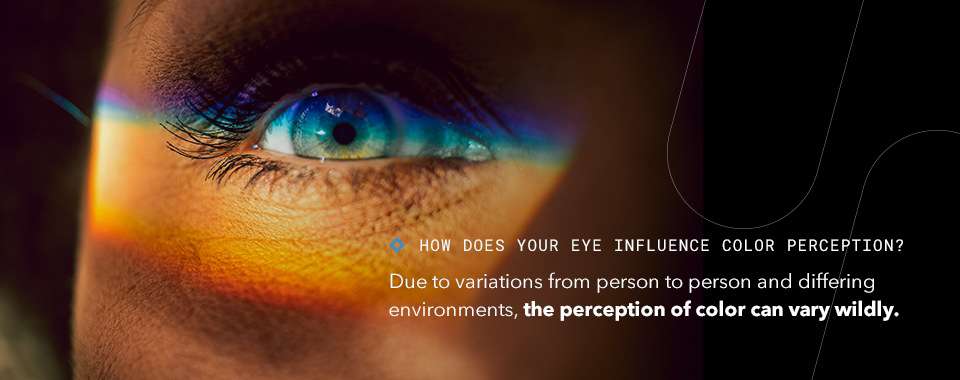
How Does Your Eye Influence Colour Perception?

The way we see colours could be more complex. The physics of colour perception involves energy wavelengths, reflections, and signals zapping back and forth in our brains. So, what is colour in science terms?

The colour-perception process doesn’t end when the light reaches your eyes. It involves the stimulation of rods and cones, which send a signal to the brain of what colour we perceive. Cones and rods are activated by different types of colours and lighting scenarios.

Due to variations from person to person and differing environments, the perception of colour can vary wildly. An object will look different in dim light versus bright light, and some people can have cones that don’t function normally, causing colour-blindness. Even with properly working cones, your brain may interpret signals slightly differently from the person next to you.

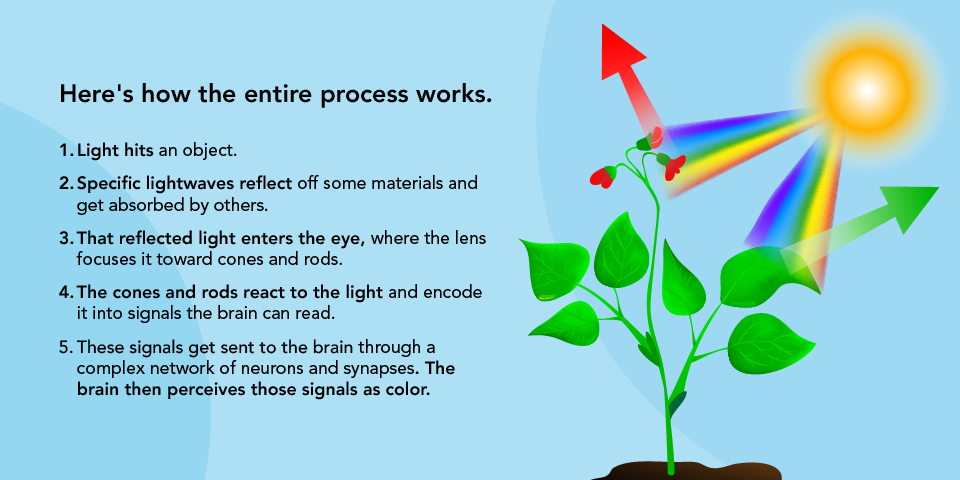
A sun projecting light onto a plant to emulate how color is perceived

Here's how the entire process works.

  1. Light hits an object.
  2. Specific lightwaves reflect off some materials and get absorbed by others.
  3. That reflected light enters the eye, where the lens focuses it toward cones and rods.
  4. The cones and rods react to the light and encode it into signals the brain can read.
  5. These signals get sent to the brain through a complex network of neurons and synapses. The brain then perceives those signals as colour.

With all these moving parts, an object that reflects specific wavelengths won't always look the same between viewers, so finding unbiased colour measurements is essential.

How Cones in Our Eyes Affect Our Vision

Those cones and rods are crucial to making sense of vision and light. Once light hits your eyes, the lens of your eye focuses it onto those light-sensitive cells, rods, and cones, each of which picks up different wavelengths of energy. Rods work best in dim light, while cones specialize in specific ranges of colours.

  • L-cones: L-cones, or red cones, make up 64% of our cones and are sensitive to the longer wavelengths that make red light.
  • M-cones: Making up 32% of cones in the eye, M-cones, or green cones, respond to medium-wavelength, or green, light.
  • S-cones: S-cones are also called blue cones since they pickup shorter wavelengths like blue. They only make up about 2-7% of total cones.
  • Rods: Rods work in low light and help us see at night without colour reception. They also play into our peripheral vision.

If you're wondering what colour humans see best, look at the M-cones. As it turns out, green is right in the middle of the spectrum and is the easiest colour to see.

What Is Colour Theory?

Colour theory combines much of the information about colour into a design tool. You're probably familiar with the colour wheel, which arranges visible colours by their natural electromagnetic wavelengths. For instance, the colour wheel moves from red, the longest, to violet, the shortest.

There are several ways to mix colours, such as additive and subtractive methods, but they usually work with primary, secondary, and tertiary colours. Primary colours are those that can't be created by mixing other colours. They are red, blue and yellow. We don't have a colour receptor for yellow, but we do have one for green. So, how do we see yellow?

There's a reason we associate yellow with sunlight and other bright lights. That's because yellow is one of the brightest colours. Detecting yellow requires our brains to combine the excitement levels of red and green cones.

Factors That Influence How We See Colour

In addition to intrinsic or taught colour perception, numerous additional variables influence colour vision:

  • Lighting: Light has a significant impact on colour perception. The hue of light influences the colour that your brain perceives. 
  • Retinal fatigue: Your eyes can get fatigued quickly. When you gaze at an object for more than a few seconds, chemicals in your eyes decrease and transmit inaccurate signals to your brain.
  • Age: As you get older, your ability to see colour fades. Fortunately, colour vision is not only innate but also an acquired skill.
  • Backdrop effects: A phenomenon known as simultaneous contrast occurs when the backdrop against which we assess colour impacts our eyes' ability to detect the colour correctly.
  • Poor colour memory: Humans have terrible colour memory. It's futile to simply gaze across the room to see if two colours match.

Environmental Influences on Colour Evaluation

What are the implications of these environmental difficulties for colour analysts and comparisons? You must grasp the effect of light on colour perception, be aware that your eyes are easy to deceive, and use the workarounds developed by colour science engineers:

  • A weary eye cannot make effective colour judgments, particularly after being overstimulated by a bright hue. Rest your eyes before observing, examine quickly, and rest again before the next colour assessment.
  • Always be mindful of your surroundings. Hues can appear different depending on the surrounding colours. When assessing colour, utilize a light booth to verify that nothing obscures your vision.
  • Determine what sort of light is illuminating your colour. A light booth can assist you in managing the illumination and maintaining uniformity.
  • To record colour information, use colour measuring equipment. A colorimeter or spectrophotometer detects reflected light from the desired sample region, and the sample is not influenced by any surrounding colours. 

The Mathematics of Colour

Subjectivity in colour perception poses a significant challenge for businesses, leading to production delays, material waste, and quality control issues. Manufacturers have embraced a mathematical approach to colour specification to attain colour accuracy and consistency.

The CIE XYZ colour space, created in 1931, is the foundation for this technique. It defines colours in a three-dimensional space using red, green, and blue values. Building on this basis, other models, such as CIELAB (1976), included characteristics such as luminance (L), red-green (A), and blue-yellow (B) axes for more complex colour representation. Another model, CIE LCh, includes lightness, chroma, and hue to provide even more detailed colour descriptors.

Colorimeters and spectrophotometers are specialized equipment used for objective colour measurement. These gadgets offer exact digital representations of colour, eliminating subjectivity. In essence, mathematics provides an objective language for colour, allowing organizations to achieve uniform colour replication while minimizing costly mistakes.

INFO  Get More Information

Measuring Colour

03-Measuring-Color.jpg

So, with all this science in mind, how do we convert that information into usable data? Let's start by looking at that system of rods and cones. Each type of cone is responsible for one colour. That means that to recreate specific colours, we have to manipulate those wavelengths. Whatever configuration they're in, the cones and rods will respond accordingly. That's how TV and mobile device screens can recreate colours — by putting three different lights — one red, one blue, and one green — into a small area on a screen called a pixel.

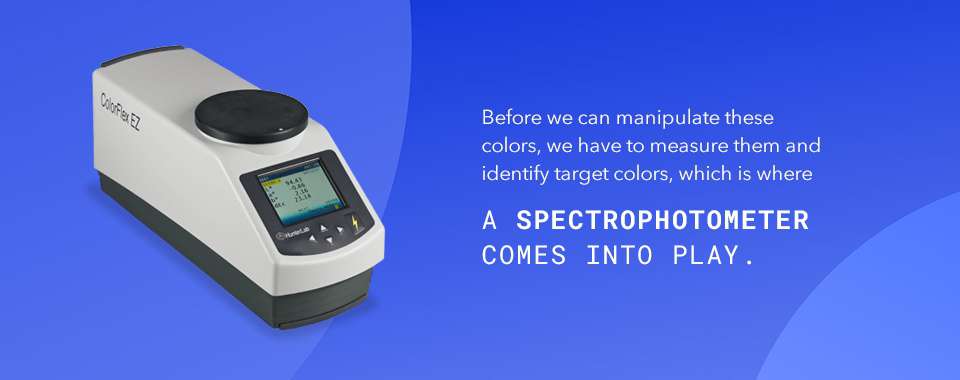
Of course, before manipulating these colours, we have to measure them and identify target colours, which is where a spectrophotometer comes into play.

A spectrophotometer is a tool that converts subjectively perceived colours into objective numbers that are used in design and communication. A spectrophotometer uses a L*a*b colour space, which identifies the relationships between certain aspects of colour and assigns a value between 100 and -100 to each one. Combining these values creates a specific number that corresponds to an exact colour.

  • L: The "L" value looks at lightness and darkness with values that represent pure white and pure black.
  • a: The "a" value looks at where a colour lies on a red-to-green spectrum.
  • b: Finally, a "b" value measures the colour between yellow and blue.

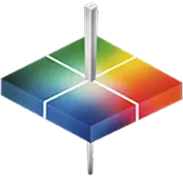
We can view L*a*b colour measurements as though they occupy three-dimensional space. Picture the L range as a pole going right down the middle of a box. The a and b values would be reflected as the x- and y-axis of a flat plane directly in the center of the box, perpendicular to the L range. As the colour becomes darker, it moves toward the bottom of the box, and as it becomes more red, blue, green, or yellow, it moves toward the corresponding edges.

Once you have this number, you can find it again later without subjectivity.

Colour Measurement Devices by HunterLab

To get these measurements, you need the right tool for the job. Spectrophotometers from HunterLab can measure everything from loose powders and meat patties to translucent liquids and plastic bottles. Each material reflects light in its own way, and using a suitable spectrophotometer is critical if you want to get the correct colour data.

With a wide array of products and a history of accuracy, HunterLab is there for you. Contact us today to learn more about measuring and working with colour.